
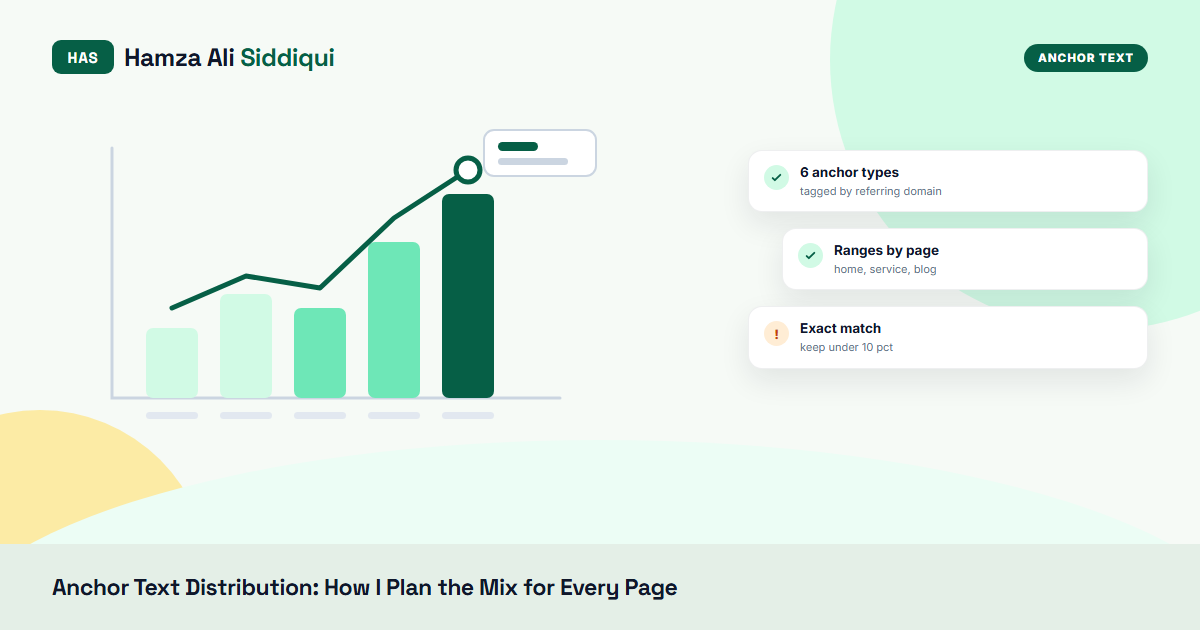
Anchor text distribution is the mix of anchor types across all the links pointing at a page: how many say your brand, how many show the bare URL, how many use the exact keyword, and so on. A natural mix leans heavily on branded, naked URL and generic anchors, with exact match kept small. When I plan links for a page, I set that mix before I order a single placement, because fixing a skewed profile later costs far more than getting it right first.
This post is the hub for everything I have written on anchors. I will show you the six anchor types I tag, the ranges I work with for each kind of page, how to measure your own anchor text distribution in about an hour, a worked example, and the mistakes that push sites into trouble.
The Six Anchor Types I Tag
You cannot judge an anchor text distribution until every anchor sits in one bucket. I use six buckets, and I keep the rules strict so two people tagging the same export get the same numbers.
| Type | Example for a page targeting “crm for plumbers” | Deep dive |
|---|---|---|
| Branded | PipeDesk, the PipeDesk team | branded anchor text |
| Naked URL | pipedesk.com, https://pipedesk.com/plumbers/ | naked URL anchors |
| Generic | this tool, read more, here | generic anchor text |
| Partial match | a CRM built for plumbing companies | partial match anchors |
| Exact match | crm for plumbers | exact match anchor text |
| Other | image links with no alt text, author names, “PipeDesk’s pricing page” | tag it, but do not stress about it |
Two tagging rules matter more than people think. Brand plus keyword (“PipeDesk CRM for plumbers”) goes in partial match, not branded, because it still carries the keyword. And a URL that contains the keyword in its slug still counts as naked URL. Google reads the words around a link too, but for counting you need clean buckets.
Why Anchor Text Distribution Still Matters in 2026
Google uses anchor text to understand what the target page is about. Its own Search Central guide on links asks site owners to write descriptive anchors, which tells you the words carry weight. The flip side sits in the spam policies: links “with optimized anchor text” in articles and press releases are listed as an example of link spam.
So anchors help when they look like what real people write, and they hurt when they look engineered. Nobody outside Google knows the exact threshold, and I do not trust anyone who quotes one as fact. What I trust is pattern matching: real editorial links mostly use brand names and URLs, because that is how writers cite things. A page where most links say the same money keyword does not look like that, and it stands out in any tool.
Anchor Text Distribution Ranges I Use, by Page Type
These are my rules of thumb, not a Google rule. They come from comparing the profiles of pages that rank well in a niche against pages that got hit, and they shift by page type. A homepage naturally attracts brand links. A blog guide naturally attracts descriptive ones.
| Anchor type | Homepage | Service or product page | Blog post or guide |
|---|---|---|---|
| Branded | 40-60% | 20-35% | 15-30% |
| Naked URL | 15-30% | 15-25% | 15-25% |
| Generic | 5-15% | 10-20% | 10-25% |
| Partial match | 5-10% | 15-25% | 20-35% |
| Exact match | 0-3% | 3-8% | 3-10% |
| Other | whatever is left | whatever is left | whatever is left |
The exact match row is the one that gets sites in trouble. I almost never go above 10% on any page, and on a young domain with few links I stay near the bottom of each range. One more thing: count by referring domain, not by total links. A single sitewide footer link can show up 4,000 times in an export and wreck your percentages if you count raw links.
How to Measure Your Anchor Text Distribution in 6 Steps
You need a backlink export (Ahrefs, Semrush, Moz or the free Google Search Console links report) and a spreadsheet. If you would rather skip the spreadsheet, paste the anchors into my free anchor text ratio checker and it does the tagging and percentages for you.
1. Export links for one URL, not the whole domain
Distribution only means something per page. A domain-wide view mixes homepage brand links with blog links and hides the one service page that is badly over-optimized. Pick the URL you care about and export its backlinks.
2. Keep one row per referring domain
Most tools have a “one link per domain” filter. Use it. If a domain links with two different anchors, keep the one in the body content and drop the sidebar or footer copy.
3. Remove the junk before you count
Scraper sites, auto-generated stats pages and dead domains inflate the “Other” bucket and the URL bucket. I filter them out first, the same way I do in a toxic backlinks review. They are not links you built and they tell you nothing about your own anchor choices.
4. Tag every anchor into one of the six types
Add a column and tag by hand, or use a few formulas: anything containing your brand goes to branded, anything starting with http or www goes to naked URL, and a short list of words (here, this, read more, website, source) goes to generic. Then sort what is left and tag the keyword anchors by eye. It is boring work, and it is where most of the insight comes from.
5. Compare against your range and against competitors
Put your anchor text distribution next to the table above, then run the same process for the top three pages ranking for your keyword. If every winner sits at 4% exact match and you sit at 22%, you have your answer. If the winners are all at 15%, the niche tolerates more, and you can relax a little.
6. Write the plan for the next batch of links
The output of the audit is not a report. It is a short list that says: the next ten links for this page get these anchors. That list goes straight into the brief I send to publishers.
A Worked Example (Hypothetical Numbers)
Say you run a service page with links from 50 referring domains. After cleaning and tagging, the anchor text distribution looks like this: 8 branded (16%), 6 naked URL (12%), 4 generic (8%), 18 partial match (36%) and 14 exact match (28%). The exact match bucket is far above my 3-8% range for a service page, and branded is well under.
You have two levers. The first is new links. If the next 30 links you build are mostly branded and URL anchors, with zero exact match, you end at 80 domains with 14 exact match anchors, which is 17.5%. Better, but still high. The second lever is editing existing links. If you can get 6 of those 14 site owners to change the anchor to the brand name (guest posts you paid for are the easiest to ask about), exact match drops to 8 out of 80, which is 10%.
Combined, that is a realistic three to four month fix. Notice what I did not do: disavow the exact match links. Those links are real and probably helping. The problem is the ratio, not the links themselves, so the fix is to dilute and adjust, not to throw them away.
How I Fix a Skewed Anchor Text Distribution
- Stop the bleeding first. Pause any vendor or package that writes exact match anchors by default. Most cheap packages do.
- Ask for anchor edits. Start with links you paid for or have a relationship with. Ask for the brand name or the URL, not a different keyword.
- Build brand-heavy links. Directory profiles, podcast show notes, partner pages and digital PR mentions almost always use the brand. My PR link building guide covers that route.
- Move the keyword into the sentence. Use a branded or generic anchor, and put the keyword in the words right next to it. You keep the context and lose the risk.
- Use internal links for exact match. Your own site is the safe place for descriptive keyword anchors. Google expects you to describe your own pages clearly.
- Pace the new links. A sudden spike of brand links looks odd too. Keep a steady link velocity.
If the page already lost rankings in a core or spam update and the exact match share is extreme, read my notes on anchor text over optimization first. Recovery takes longer than prevention, and the order of the steps matters.
Anchor Text Distribution Mistakes I See in Audits
- Counting raw links instead of domains. One sitewide link can make up half the export. Always dedupe by domain.
- Judging the whole domain. The homepage looks fine and hides a money page sitting at 30% exact match.
- Copying a “perfect” ratio from a blog post. Including this one. Use the ranges as a starting point, then check what actually ranks in your niche.
- Tagging brand plus keyword as branded. It flatters the numbers and hides the risk.
- Forcing variety with weird anchors. Ten slightly different keyword phrases (“best crm plumbers”, “plumber crm best”) still read as keyword anchors to a human and probably to Google.
- Fixing anchors on links that are not indexed. Check the link is live and indexed before you spend an email asking for an edit.
Anchor Text Distribution Checklist
- Export backlinks for one URL at a time
- Dedupe to one link per referring domain
- Remove scrapers and dead domains before counting
- Tag into six buckets with strict rules
- Compare against the range for that page type
- Benchmark the top three ranking pages for the keyword
- Keep exact match under 10% on every page, lower on young sites
- Write anchors for the next 10 links into the publisher brief
- Re-run the audit every quarter, or after every 20 new links
FAQ
What is a good anchor text distribution?
For most pages, a good anchor text distribution is mostly branded, naked URL and generic anchors, with partial match in the middle and exact match under about 10%. Homepages should be even more brand heavy. Check what the top ranking pages in your niche look like before you set a target.
Should I count links or referring domains?
Referring domains. Sitewide links from footers and sidebars can repeat thousands of times and make one anchor look dominant when it comes from a single site.
Does anchor text distribution apply to internal links?
Not in the same way. Internal links are your own description of your own pages, so descriptive keyword anchors are fine there. I still vary them a little so the text reads naturally.
How often should I check my anchor text ratios?
Once a quarter for active pages, or after every 20 or so new links. Check sooner if you notice a ranking drop after an update.
Can a bad anchor mix cause a penalty?
Yes. Google lists links with optimized anchor text as an example of link spam, and a heavy exact match share is one of the clearest signals of built links. Most of the time the result is an algorithmic drop rather than a manual action, which is harder to spot.
Is there a free way to check my anchor text distribution?
Yes. Export links from Google Search Console, then paste the anchors into my free anchor text ratio checker, which groups them and shows the percentages.
Plan the Anchor Text Distribution Before the Links
Anchor text distribution is one of the few parts of link building you fully control. You cannot force a site to link to you, but you can decide what you ask for. Tag your current links, compare them to a sensible range for the page type, and write the next batch of anchors before you order or pitch anything.
If you would like someone to plan and build that mix for you, take a look at my link building services. Every campaign I run starts with an anchor plan for each target page, so the links help rankings instead of creating a problem you have to clean up later.