
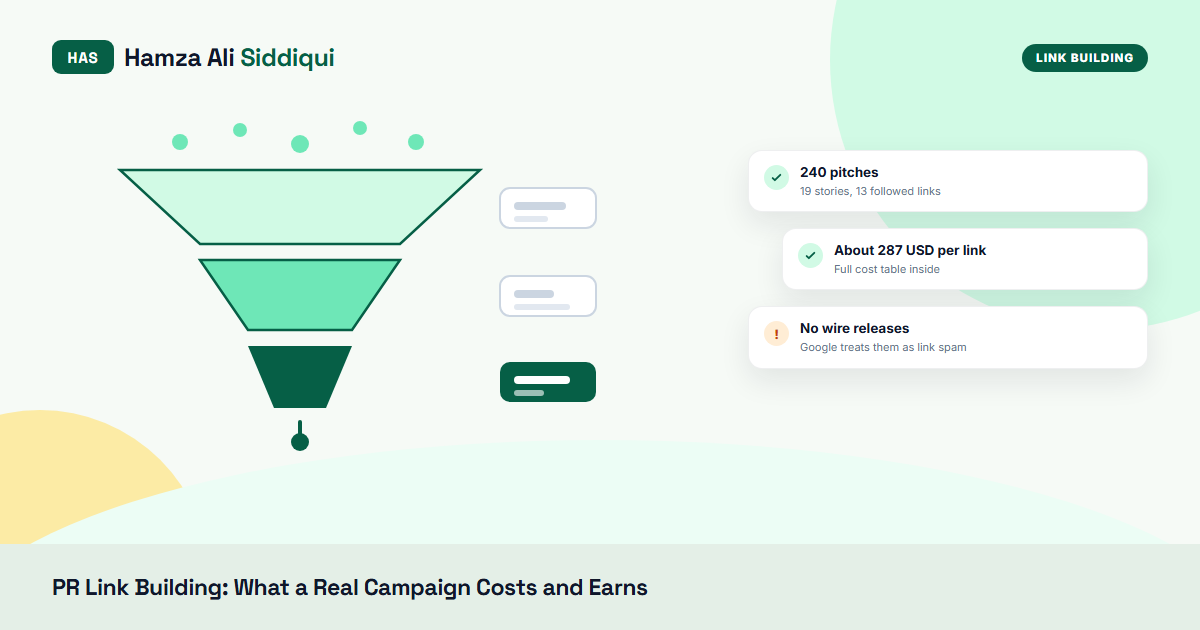
In early 2024 a client of mine, a small invoicing tool for freelancers, asked me why their competitor kept showing up in Forbes and Business Insider while they were stuck buying guest posts. My honest answer was that the competitor was doing PR link building and they were not. So we tried it. One survey, 240 pitches, 19 pieces of coverage and 13 followed links later, I had real numbers on what this tactic costs and what it gives back. This post is those numbers, plus the parts most guides skip.
Short version first: PR link building works, but it is slower and lumpier than people expect, and the links you get are ones you cannot control. If you need a specific anchor on a specific page next month, this is the wrong tool.
The campaign that taught me how PR link building really works
Here is the full breakdown of that invoicing campaign. I am sharing it because almost every article on the first page of Google for this topic lists tactics, and almost none shows a single campaign from start to finish with the bill attached.
The hook was simple. We surveyed 412 US freelancers about late payments. The headline stat: 61 pct of them had waited more than 30 days past the due date on at least one invoice in the last year, and the average unpaid amount at any moment was $3,180. Journalists who cover small business and the gig economy like this kind of number because it gives them a fresh line for a story they already write.
| Item | Number |
|---|---|
| Survey panel (412 responses) | $1,150 |
| Charts and a simple landing page design | $300 |
| My time (list building, pitching, follow-ups) | 38 hours, billed at $60 = $2,280 |
| Total cost | $3,730 |
| Journalists pitched | 240 across 3 waves |
| Replies | 31 (12.9 pct) |
| Pieces of coverage | 19 |
| Coverage with any link | 14 |
| Followed links | 11 (3 were nofollow) |
| Unlinked mentions later reclaimed | 2 of 5 |
| Final followed links | 13 |
| Cost per followed link | about $287 |
Is $287 per link good? Compared with a decent guest post, it is roughly the same money. In my link building cost breakdown a solid guest post on a DR 50 site lands somewhere between $150 and $400 at the time of writing. The difference is what you get for that money. Four of those 13 links came from sites with DR 80 or higher, sites that do not sell posts at any price. The client’s late-payment guide moved from position 14 to position 6 over the following ten weeks, and their homepage picked up branded searches it never had before.
The part nobody puts in their case study: wave one (80 pitches) produced only 2 stories. I almost called it a failure. Waves two and three worked because I rewrote the angle for each beat, which I explain below.
What counts as PR link building (and what does not)
PR link building means earning links from journalists, editors and publishers because you gave them something worth covering: data, an expert comment, a story, a reaction to news. You do not pay for the placement and you do not pick the anchor. That is what makes these links editorial links in the truest sense.
The data-led route is the one I use most often, and I break it down step by step in my guide to data-driven link building.
What it is not: sending a press release through a wire service and counting the syndicated copies as backlinks. Google’s spam policies name links with optimized anchor text in press releases distributed on other sites as an example of link spam. Wire releases still have a place for real announcements, but treat any link inside them as zero SEO value.
Here is how PR links compare with the other link types my clients usually buy:
| PR links | Guest posts | Niche edits | |
|---|---|---|---|
| Control over anchor | Almost none (mostly brand) | High | High |
| Control over target page | Low | High | High |
| Typical site authority | DR 60 to 90+ | DR 30 to 60 | DR 30 to 60 |
| Cost per followed link (my numbers) | $200 to $600 | $150 to $400 | $100 to $350 |
| Time to first link | 3 to 8 weeks | 1 to 3 weeks | 1 to 2 weeks |
| Penalty risk | Very low | Low to medium | Medium |
Because almost every PR link uses your brand name or a naked URL as anchor, a PR campaign also fixes skewed anchor profiles. If your profile is heavy on exact match, run it through my free anchor text ratio checker before and after a campaign. You will usually see the branded share jump.
Two routes: reactive PR and data-led PR
Every PR link building plan I run falls into one of two buckets. They need very different budgets, so pick one deliberately.
Reactive PR: answering journalist requests
Journalists post requests every day on platforms like Qwoted, Featured and Source of Sources, the newer cousins of the old HARO. You answer with a short, quotable expert comment. I wrote a whole guide on HARO link building, and most of it still applies.
For one founder client last spring I answered 46 requests over 30 days. Five got published, and three of those included a followed link. That was about 11 hours of work. Cheap, steady, but small. Reactive PR suits a founder with real expertise who can spare 20 minutes a day.
Data-led PR: giving journalists a story
This is the invoicing campaign above. You create something new (a survey, an analysis of public data, an index, a ranking) and pitch it to reporters on the relevant beat. It costs more and the results swing wildly. My worst data campaign got 2 links. My best got 41. The Ahrefs guide to digital PR has good examples of the formats that tend to travel.
My PR link building budget by route
| Route | Monthly spend | Hours | Followed links I usually see |
|---|---|---|---|
| Reactive, do it yourself | $0 to $100 (platform plan) | 8 to 12 | 1 to 4 |
| One data campaign, do it yourself | $1,000 to $2,500 once | 30 to 45 | 3 to 20 |
| Freelancer running reactive + 1 data story a quarter | $1,500 to $3,000 | Your time: 2 to 3 | 4 to 10 a month |
| Specialist digital PR agency | $5,000 to $15,000 | Your time: 3 to 5 | 8 to 30 a month |
Those agency numbers are wide on purpose. I have seen a $6,000 retainer beat a $14,000 one because the cheaper team actually understood the client’s industry. Ask for three campaigns with link counts, not coverage counts, before you sign anything.
How I run a data-led campaign in 6 weeks
- Week 1: find the beat, then the question. I read the last 30 stories from the reporters I want. What numbers do they keep quoting? What is old or missing? The invoicing survey came from noticing that every gig-economy story cited the same 2019 stat.
- Week 2: collect the data. Survey panel, public datasets (BLS, Census, Google Trends) or your own anonymised product data. Aim for one headline number and three supporting ones.
- Week 3: build the landing page. Methodology, charts people can embed, a few quotes from your founder. This is the page the links will point to, so make it the most useful version of the story.
- Week 3: build the list. 80 to 120 reporters per angle, by beat, with a recent article of theirs you actually read.
- Week 4: pitch wave one, then read the replies. Silence tells you the angle is wrong. Rewrite before you send more.
- Weeks 5 and 6: local and niche angles. Cut the data by state, city or job type and pitch regional press. In the invoicing campaign, “Texas freelancers wait longest” got more pickups than the national story.
- After: reclaim and recycle. Search for coverage without a link and ask politely, the same way I describe in my guide to unlinked brand mentions. Then reuse the data in sales decks and guest posts.
The pitch I sent in wave two
Wave one opened with the company. Wave two opened with the reporter’s own recent story. That one change took the reply rate from 4 pct to 17 pct. Here it is, roughly as sent:
Hi Sarah, your piece last week on freelancers and rising rents quoted the 2019 Upwork number on late payments. We just surveyed 412 US freelancers and the picture is worse: 61 pct waited 30+ days past due on at least one invoice this year, and the average amount owed at any time is $3,180. Full method and state-level data here [link]. Happy to share the raw file or get you a quote from our founder. No pressure either way.
Under 90 words. One number in the first two lines. No request for a link. Asking for a link in a PR pitch is the fastest way I know to get ignored.
Checklist before you send a single pitch
- Is the headline number new, or did someone publish it in the last 12 months?
- Can a reporter understand the story from the subject line alone?
- Is the method on the page (sample size, dates, who was asked)?
- Do you have at least one local or niche cut of the data?
- Is a spokesperson ready to answer within two hours?
- Does the landing page load fast and work on mobile?
- Does every pitch mention something specific the reporter wrote?
- Have you set up brand alerts so you catch coverage without links?
Mistakes I keep seeing
Counting coverage instead of links. An agency report showing “47 placements” can hide 6 followed links. Ask for the link count, the follow status and the domain rating for each one.
Expecting links to commercial pages. Journalists link to the data page or the homepage. If you need your pricing page to rank, add internal links from the PR landing page to it. That is where the authority moves.
Paying for “guaranteed” placements. Some sellers offer guaranteed features on big news sites. Those are usually sponsored content, which should carry a rel=”sponsored” attribute per Google. Nice for brand, weak for rankings.
Giving up after one campaign. My clients who got real results ran four or more campaigns a year. The reporter list gets warmer each time, and the second campaign is always cheaper than the first.
Ignoring nofollow links. Three of the 19 stories in my example were nofollow. They still sent referral traffic and one of them led a podcast host to invite the founder on, which became a followed link later. I covered why in do nofollow links help SEO.
When PR link building is the wrong choice
I tell about a third of the people who ask me about PR to skip it for now. If your site has fewer than 20 referring domains and you need a few product pages to rank in a low-competition niche, a handful of relevant guest posts or niche edits will get you there faster. If you sell something boring with no data and no founder who wants to talk to reporters, reactive PR will struggle too.
If you are still deciding whether PR fits your budget at all, my breakdown of the types of backlinks puts it next to guest posts, insertions and the free options.
PR link building is the right choice when your competitors already have strong links, when you need authority across the whole domain rather than one page, or when you are in a niche (finance, health, legal) where buying links is risky. If you want help deciding which mix fits your site, my link building services page explains how I run both sides for clients.
FAQ about PR link building
Is PR link building safe for SEO?
Yes, it is the safest kind of link building I know. The links are given by editors because the story is useful, which is exactly what Google wants links to be. The only risky version is paid wire releases or “guaranteed” placements pretending to be editorial.
How much does PR link building cost?
In my campaigns a followed link has cost between $200 and $600. A do-it-yourself data campaign runs $1,000 to $2,500 plus 30 to 45 hours. Specialist agencies charge $5,000 to $15,000 a month at the time of writing.
How long until PR links show up?
Reactive answers can get published within days. A data campaign usually takes 3 to 8 weeks for the first links, and coverage keeps trickling in for months as other writers cite the original stories.
Do press releases help with SEO?
Not directly. Links inside syndicated wire releases are treated as having no value, and keyword anchors in them are named in Google’s spam policies. A press release can still lead to real coverage if a journalist picks the story up and writes their own piece.
Can a small business do PR link building without an agency?
Yes. Start with reactive PR for 20 minutes a day, then try one small data story using your own customer data. My invoicing client’s first campaign was run by me alone in about 38 hours.