
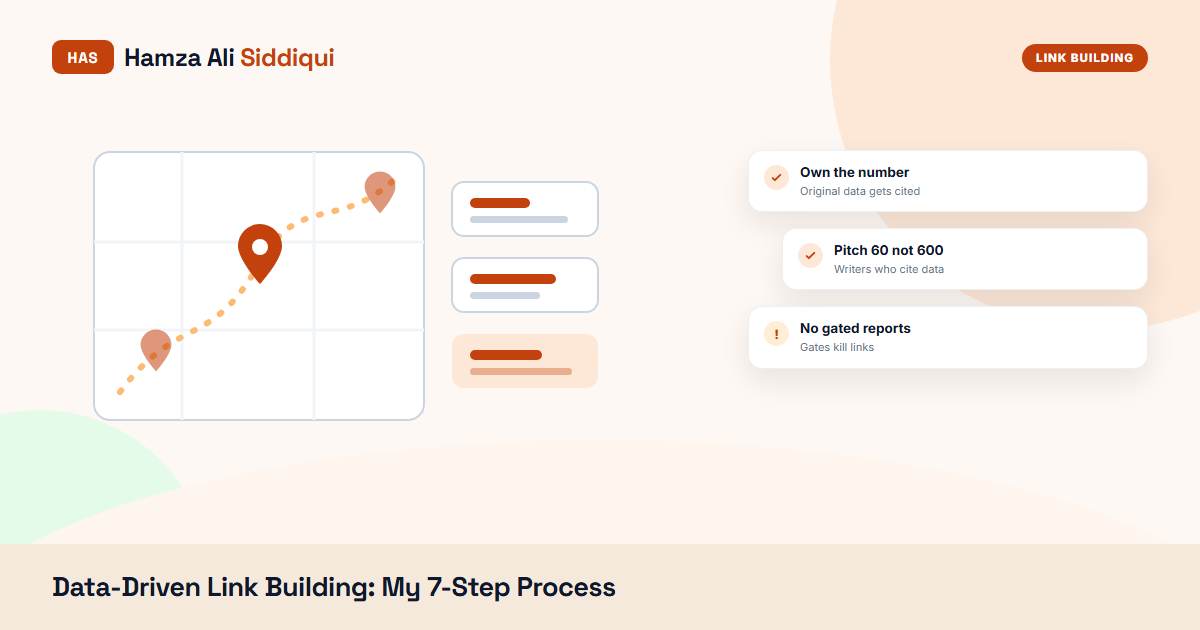
Data-driven link building means you create a small piece of original data, turn it into a story a journalist or blogger can use, and earn links when they cite you as the source. That is the whole idea. You are not asking for a link. You are giving people a number they cannot get anywhere else, and the link comes with the citation.
I have been building links since 2019, and this is the method I trust most when a site has nothing “linkable” yet. It is slower than buying a guest post. It is also the only route I know where one good dataset can keep pulling links for a year without another email. Below is the exact process I follow, the free data sources I use, a pitch you can copy, and the mistakes that quietly kill most campaigns.
What Data-Driven Link Building Actually Is (and Is Not)
A lot of agencies now put “data-driven” on every service page. Most of the time they mean they looked at Ahrefs before sending outreach. That is just doing your homework. Real data-driven link building is about the asset: the thing people link to is data you collected, combined or analysed yourself.
| Approach | What gets linked | Counts as data-driven? |
|---|---|---|
| Original survey | Your survey results page | Yes |
| Public dataset analysis | Your analysis of government or open data | Yes |
| Your own product or platform data | An anonymised report from your users | Yes, and usually the strongest |
| Scraped or compiled index | A ranking you built from many sources | Yes, if the method is clear |
| Using SEO metrics to pick prospects | A normal guest post or niche edit | No, that is just targeting |
| Rewriting someone else’s statistics | A stats roundup | Weak, links usually go to the original source |
That last row matters. Stats roundups can earn links, but writers who care about accuracy click through to the original study and cite that instead. If you want to be the source, you have to own the number.
Why This Works Better Than Asking for Links
Journalists and bloggers need numbers. A sentence like “remote workers spend more on coffee” is an opinion. A sentence like “remote workers in our survey spent more on coffee than office workers” is a fact with a source, and a source needs a link. You are solving their problem, which is why the reply rate on a good data pitch is so different from a cold “can you add my link” email.
It also sits on the right side of Google’s rules. The Google Search Central spam policies warn against buying links and excessive link exchanges, but links that writers give freely because they are citing your work are exactly what the system is built to reward. These are editorial links in the purest sense.
My 7-Step Data-Driven Link Building Process
1. Start from the headline, not the data
This is the step most people get backwards. They collect a pile of data and then hunt for a story inside it. I do the opposite. I write five or six headlines that a writer in the client’s niche would genuinely want to publish, then I ask what data would prove or disprove each one.
A quick way to find those headlines: search Google News for the niche, look at the last month of articles, and note every time a writer says “according to” or “a recent study found”. Those are the gaps. If writers keep citing one old study from 2021, a fresh version for 2026 is an easy pitch.
2. Pick the cheapest data source that can answer it
You do not need a research budget to start. Here is where I look first, roughly in order of cost:
| Data source | Cost | Best for | Watch out for |
|---|---|---|---|
| Client’s own anonymised data | Free | SaaS, ecommerce, marketplaces | Privacy, get sign-off in writing |
| Government open data (for example Data.gov) | Free | Local, cost of living, health, jobs | Messy files, old releases |
| Google Trends | Free | “Most searched” by state or country | Relative numbers only, not volumes |
| Review sites and public listings | Free to low | Price comparisons, ratings indexes | Terms of use, sample bias |
| Paid survey panel | Medium to high | Opinions and behaviour | Leading questions, small samples |
My honest advice: if the client has their own data, use it. A report built on a company’s own platform data is something no competitor can copy, and writers know it.
3. Keep the analysis boring and checkable
Writers will not cite a number they cannot explain to their editor. So I keep the method simple: clear sample size, clear dates, clear definitions. A ranking of 50 cities on three factors that anyone can understand beats a clever index with 14 weighted variables nobody trusts.
4. Build one page that is easy to cite
The landing page is where the links point, so it has to do the writer’s job for them. Mine always have:
- Three to five key findings at the top, each one a single sentence a writer can paste.
- A short methodology section with the sample, the dates and the source.
- One or two simple charts saved as images, with permission to reuse them if credited.
- A full data table lower down for the writers who want to dig.
- A line saying who to contact for comment, with a real name.
Put this page on a normal URL in the blog or a resources section, not a campaign microsite. You want the authority to stay on the main domain and flow to your money pages through internal links.
5. Build a prospect list of people who already cite data
I do not pitch “journalists in finance”. I pitch the specific writers who covered a similar statistic in the last six months. Search for the topic plus words like “survey”, “study” or “data”, note the author, and find their email or their page on a journalist database. A list of 60 well-matched writers beats 600 random ones every time.
6. Send a short pitch with the best number in the subject line
Here is the template I start from. Keep it under 120 words.
Subject: New data: [one surprising finding in plain words]
Hi [Name], I saw your piece on [topic] last month. We just finished a study of [sample, for example 1,000 US renters] and found that [finding one]. Two more findings: [finding two] and [finding three]. The full results, method and free-to-use charts are here: [link]. Happy to share the raw data or get you a quote from [expert name] if it helps. Thanks, [Your name]
No “I hope this email finds you well”. No ask for a link. The link happens when they cite the source.
7. Run a second wave and reclaim the missing links
After the first round of coverage, I pitch again using the coverage itself: “this was featured in X, here is a local angle for your city”. Then I search for mentions of the study that did not link and politely ask for the credit. That is the same process I describe in my unlinked brand mentions guide, and with data campaigns it often finds more links than the first pitch did.
A Worked Example (Hypothetical Numbers)
To make the time and cost clearer, here is a made-up but realistic plan. Say you run a meal-kit store and want links to its blog. These numbers are for illustration, not results from a real campaign.
| Stage | What you do | Rough time |
|---|---|---|
| Headline ideas | Six headlines around “cost of cooking at home vs eating out by state” | 2 hours |
| Data | Pull public food price data plus your own average basket cost | 6 to 8 hours |
| Analysis | Rank all 50 states on one simple savings number | 4 hours |
| Landing page | Findings, method, two charts, full table | 5 hours |
| Prospects | 60 food, money and local news writers who cited similar data | 4 hours |
| Outreach | First wave, follow-up, local second wave | 6 hours |
That is roughly 27 to 29 hours of work. Say only one in ten writers uses it in the first wave. Six citations from real news and finance sites can still be worth more than twenty cheap guest posts, and local outlets in the top and bottom states often run their own version weeks later. If you want to compare that against paying per link, my guest post price calculator gives you the other side of the math.
Data-Driven Link Building Checklist
I run through this before any pitch goes out:
- Does the headline work without the brand name in it?
- Can a writer explain the method in one sentence?
- Is the sample size and date range on the page?
- Is there at least one finding that surprised me?
- Are the charts readable on a phone?
- Does every prospect on the list have a recent article on this topic?
- Is there a named person available for a quote?
- Does the landing page link to one or two relevant money pages?
Mistakes That Kill Data Campaigns
Making the brand the story. “Company X launches report” gets ignored. “Renters in Texas pay more for X than anywhere else” gets picked up.
Weak samples. A survey of 87 people will get you questioned or ignored by any serious outlet. If you cannot afford a decent sample, use public data instead.
Hiding the method. If writers cannot see how you got the number, many will not risk citing it.
Gating the data. An email form in front of the results is the fastest way to lose links. Give it away.
Pitching off-topic writers. A tech reporter does not care about your pet food survey, no matter how good it is.
Stopping after one wave. The second wave and the unlinked-mention sweep are where a lot of the value sits.
When I Would Not Use Data-Driven Link Building
It is not right for every site. If you need ten links to a product page next month, this is too slow and too indirect. If the niche has no press coverage at all, there is nobody to pitch. And if the client cannot sign off on sharing any internal numbers, you are limited to public data, which more competitors can copy.
In those cases I mix in faster tactics like resource page link building or targeted guest posts, and keep one data project running in the background. For a fuller look at how a pure PR approach compares, see my guide to PR link building.
FAQ
What is data-driven link building?
It is earning backlinks by publishing original data, such as a survey, a public dataset analysis or anonymised product data, and pitching the findings to writers who then cite and link to your page as the source.
How much does a data-driven link building campaign cost?
If you use free public data or your own data, the main cost is time, often 25 to 40 hours for a small campaign. Paid survey panels add to that. Agencies usually charge more than per-link services because the work is closer to PR.
How long until a data campaign earns links?
The first citations usually come within a few weeks of the pitch. The bigger benefit is that a strong dataset keeps getting cited for months as writers find it through search.
Do I need a big survey to do this?
No. Public data, Google Trends and your own platform data can all work. A small survey is often worse than good public data because writers question weak samples.
Is data-driven link building safe for SEO?
Yes. Writers choose to cite and link to your work, which is the kind of editorial link Google wants. Just do not pay for coverage or ask for keyword-rich anchors.
Final Thoughts
Data-driven link building rewards patience. You spend a few days building one useful dataset, and if the headline is right, writers do the linking for you. Start with the headline, keep the method simple, give the data away and pitch only the people who already cover your topic.
If you would rather have someone plan and run a data-driven link building campaign alongside faster tactics, take a look at my link building services. I am happy to tell you honestly whether your niche suits it before you spend anything.