
Resource page link building is the most boring tactic I still use, and it is one of the few that keeps working year after year. You find pages that exist only to list useful links, you check that your page deserves a spot, and you ask the person who maintains the list to add it. No guest post to write. No fee to negotiate.
I have run it for clients since 2019. The guides that rank for this topic explain the search operators well, then stop. They do not tell you how many pages you will throw away, how many hours a link costs, or why most pitches get ignored. So I am going to start with the numbers from my most recent campaign and work backwards from there.
My Last Resource Page Link Building Campaign, in Numbers
The client was a small bookkeeping SaaS for freelancers. The asset was a free invoice template page with a short guide on late payment fees. Nothing fancy, but genuinely useful, and that matters more than design here. I ran the campaign over five weeks in mid 2026, mostly in two-hour blocks.
| Stage | Count | What happened |
|---|---|---|
| Pages found with search operators | 412 | Raw list from Google, deduplicated by domain |
| Pages that passed my checklist | 133 | The rest were dead lists, spam directories or off topic |
| Contacts found and pitched | 118 | 15 pages had no findable owner |
| Replies | 23 | 19.5 pct reply rate, including the “no thanks” ones |
| Links added | 14 | 11.9 pct of pitches, 12 of them dofollow |
| Total time | 31 hours | About 2.2 hours per link |
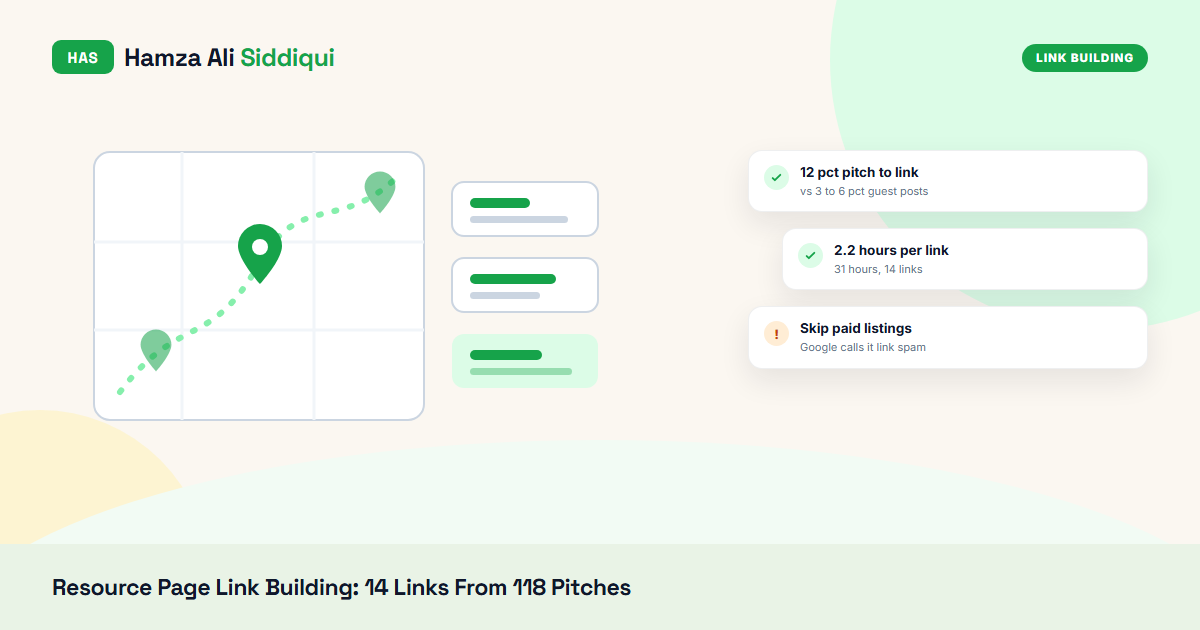
Two things stand out. First, two thirds of what the search operators return is junk. If you skip qualifying and pitch everything, your reply rate drops and you burn your email domain for nothing. Second, a 12 pct win rate is far better than cold guest post outreach, where I usually see 3 to 6 pct. For comparison, the Backlinko and Pitchbox study of 12 million outreach emails found an average response rate of 8.5 pct, and that counts replies, not links.
Within 90 days of that resource page link building push, the template page moved from position 31 to position 9 for its main term. The links were not powerful one by one. Most came from DR 20 to DR 50 sites. But they were topical, editorial and on pages that Google already crawls often.
What Counts as a Resource Page (and What Does Not)
A real resource page is a curated list somebody maintains because it helps their own readers. Think “Freelancer tools we recommend” on a coworking space site, “Small business resources” on a library or chamber of commerce site, or a university career office page that links to salary calculators.
What does not count: pages titled “Submit your link” with 600 outbound links, link exchange pages, and anything that asks for money to be listed. Google is direct about this in its link spam policy, which names low-quality directory and bookmark links as an example of manipulation. A paid listing on a resource page is just a paid link with a nicer label. If you want the honest version of that trade, I wrote about it in my post on paid backlinks.
The 6 Steps I Follow
1. Pick a page that deserves to be listed
This is where most resource page link building fails before it starts. Nobody adds a pricing page or a “10 reasons to choose us” post to their list. They add free templates, calculators, checklists, glossaries and honest guides. If you do not have one, build one first. My guest post price calculator exists partly for this reason: a free tool is the easiest thing in the world to pitch.
A simple test I use: would a librarian link to it? If the honest answer is no, change the asset, not the pitch.
2. Find pages with search operators
Google’s own search operators documentation covers the basics. These are the strings that return the most usable pages for me, with my rough keep rate from the campaign above.
| Search string | Keep rate | Note |
|---|---|---|
| “keyword” intitle:resources | About 40 pct | Best general starting point |
| “keyword” inurl:links | About 20 pct | Many old, dead lists |
| “keyword” “useful links” | About 35 pct | Good for niche blogs |
| “keyword” site:.edu inurl:resources | About 25 pct | Slow to reply, strong links |
| “keyword” “recommended tools” | About 45 pct | Best for SaaS and tools |
| intitle:”keyword” “helpful resources” -pdf | About 30 pct | Removes PDF noise |
For resource page link building, swap “keyword” for the topic of your asset and a few close variants, like “freelance”, “invoicing” and “small business finance”. Then do one more trick: put the URL of a resource page you already like into Ahrefs or a free backlink checker and look at who else links to the same tools. Similar lists tend to cluster.
3. Qualify every page before you pitch
This is the step I would never outsource to a junior without a checklist. Here is the checklist I use for resource page link building. A page needs at least six of these eight to stay on the list.
- The page is indexed (search the exact URL in Google).
- It was updated in the last 18 months, or at least has no more than one broken link in ten.
- It lists fewer than 100 outbound links.
- The topic matches your asset closely, not loosely.
- The site gets some organic traffic in Ahrefs or Semrush.
- The links on it are mostly dofollow, or you are fine with nofollow.
- There is a real person or team you can contact.
- Nothing on the page mentions paying for a listing.
The second point is a hidden gift. If a page has dead links, you have a reason to write that does not sound like a sales email. Link rot is huge: an Ahrefs link rot study found that 66.5 pct of links to the sites they tracked over nine years had died. Telling a page owner which of their links are broken is a favour first and a pitch second.
4. Find the person who edits the page
On small sites, the contact page or the author byline is enough. On universities and libraries, the page footer often names the staff member who maintains it, and that person replies far more often than a general inbox. I spend no more than four minutes per page here. If I cannot find a name, the page goes to a “maybe later” tab.
5. Send a short, specific pitch
My best performing email in the campaign was 74 words long. It named the page, pointed out one broken link with its exact anchor, and offered our template as a possible addition. No “I hope this email finds you well.” No list of our achievements.
Subject: Broken link on your freelancer resources page
Hi Sarah, I was going through your Freelancer Resources page and the “Invoice Basics” link in the Getting Paid section now goes to a 404.
If you are looking for a replacement, we built a free invoice template with a short guide on late fees: [URL]. No signup needed. Totally fine if it is not a fit.
Thanks for keeping that list going, it is a good one. Hamza
6. Follow up once, then track
One follow-up after five working days. Not two, not three. In resource page link building, patience beats volume. In my campaign, 6 of the 14 links came from the follow-up, so it matters, but a third email only annoys people. Log every live link with its date, anchor and rel attribute, then check them every month. Resource pages get cleaned up, and you want to know when yours disappears. My guide on checking if backlinks are indexed covers the monthly routine I use.
Time and Cost Breakdown per Link
People ask me whether resource page link building is “free”. The links are free. The hours are not. Here is how my 31 hours split, and what that looks like in money at a few common rates.
| Task | Hours | Share |
|---|---|---|
| Searching and collecting pages | 6 | 19 pct |
| Qualifying with the checklist | 11 | 35 pct |
| Finding contacts | 6 | 19 pct |
| Writing pitches and follow-ups | 6 | 19 pct |
| Tracking and replies | 2 | 8 pct |
| Total for 14 links | 31 | 2.2 hours per link |
At $15 an hour for a trained VA, that is about $33 per link. At $50 an hour for an experienced outreach person, it is about $110. Both numbers are well below the $200 to $400 I see for a decent guest post or niche edit at the time of writing, which I broke down in my link building cost post. The catch with resource page link building is volume. You will not get 50 resource links a month for one asset. Ten to fifteen per campaign is a good result.
Mistakes That Kill Resource Page Link Building
- Pitching your homepage. Resource pages link to resources. A homepage is an ad.
- Skipping the update check. A list last touched in 2017 has no editor. You are writing to nobody.
- Mass templates with merge tags. “Hi {first_name}, love your {page_title}” gets spotted in one second. I write the first line of every email by hand.
- Ignoring nofollow lists. A nofollow link from a busy .edu resource page can still send real visitors. I explain why in do nofollow links help SEO.
- Forcing exact match anchors. You rarely control the anchor here, and that is a good thing. Most resource links use the page title or brand name, which keeps your profile natural. You can check your mix with my anchor text ratio checker.
- Paying for “resource page placements”. If someone sells it, it is not a resource page.
When Resource Page Link Building Is Not Worth It
I do not use it for every client. If the business has nothing helpful to give away and no budget to build it, the campaign will stall. The same goes for very commercial niches like casinos, CBD or payday loans, where almost no curated lists link out anymore.
It also will not move a new site to page one for a competitive money keyword on its own. I treat it as the steady base of a link profile, mixed with editorial links, a few guest posts and unlinked brand mentions. If you would rather not spend 30 hours on outreach yourself, this is exactly the kind of campaign I run in my link building services.
Quick Checklist Before You Start
- One free, useful asset is live and fast.
- You have 5 to 8 topic variants to search with.
- Your qualifying sheet has the 8 checks as columns.
- You have a 70 to 90 word pitch with one personal line.
- Follow-up is set for day five, and only once.
- A tracking tab logs URL, date, anchor and rel.
FAQ
Is resource page link building still effective in 2026?
Yes, if your asset is genuinely useful. My last campaign turned 118 pitches into 14 links, which is a better win rate than cold guest post outreach. It works worst for sites with nothing to give away.
How many links can I expect from one resource page link building campaign?
For one asset in a normal niche, 10 to 15 links over four to six weeks is a realistic target. Bigger niches with many curated lists, like education or personal finance, can give more.
Are .edu resource pages worth the effort?
They reply slowly and many lists are abandoned, but the ones that are maintained give strong, trusted links. I keep .edu pages to about a quarter of a campaign so they do not slow everything down.
Should I pay to be listed on a resource page?
No. A paid listing is a paid link, and Google’s spam policy treats it that way. A real resource page adds links because they help readers, not because of a fee.
What is the difference between resource page and broken link building?
Resource page outreach targets curated lists. Broken link building targets any page with a dead link. They overlap a lot, and I often use a broken link on a resource page as the opening line of the pitch.