
Exact match anchor text is the fastest way to tell Google what a page is about, and the fastest way to get that page filtered if you push it. I have been building links since 2019, and anchor ratios are the single thing I argue about most with clients who want their money page to rank this quarter. This post is what I actually tell them: how much exact match anchor text is safe, when I use it, and how to fix a profile that already went too far.
What counts as exact match anchor text
An anchor is exact match when the clickable text is your target keyword and nothing else. If the page targets “project management software”, then that phrase on its own is exact match. Add a word and it becomes partial match. Use the company name and it is branded.
Here is the same target keyword written six ways, which is how I explain it in client calls.
| Anchor | Type | Risk |
|---|---|---|
| project management software | Exact match | High in volume |
| best project management software for agencies | Partial match | Low |
| Acme | Branded | None |
| Acme project management software | Brand plus keyword | None |
| this guide | Generic | None |
| acme.com/software | Naked URL | None |
One detail people miss: plurals and small variations still read as exact match to most link auditors, including me. “Project management softwares” is not a clever workaround.
How much exact match anchor text is safe
There is no published limit. Google’s spam policies only say that links with keyword-rich anchors placed on other sites for ranking purposes count as link spam. So the working numbers below come from profiles I have audited, not from a Google document. They are the bands I use when I decide whether a client needs to slow down.
| Share of exact match anchors | What I see at this level | My call |
|---|---|---|
| 0 to 3 percent | Typical for a site that has never bought a link | Room to push |
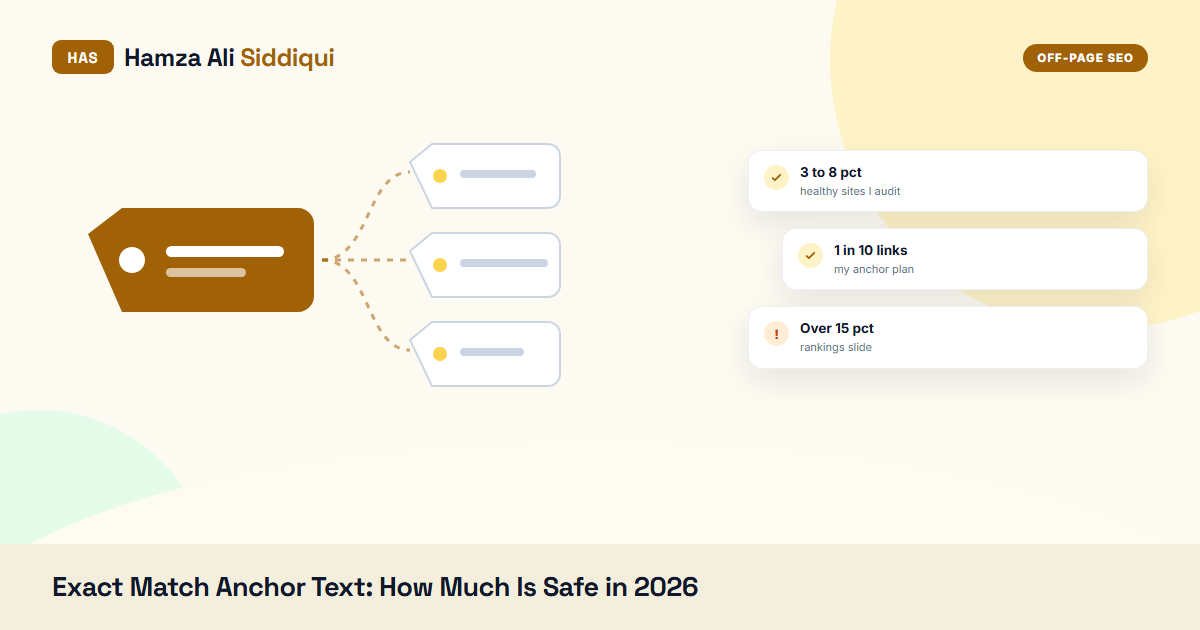
| 3 to 8 percent | Most healthy commercial sites I work on | Comfortable |
| 8 to 15 percent | Aggressive, common on sites that bought a batch | Stop and rebalance |
| Over 15 percent | Ranking drops usually show up within two core updates | Cleanup work |
Those percentages are for the whole domain. The number that actually gets pages filtered is the one per URL. A site can sit at 5 percent overall while one pricing page sits at 40 percent, and that pricing page is the one that stops ranking. Check both. My free anchor text ratio checker does the per-page split in a few seconds.
When I do use exact match anchor text
- Internal links. No limits here in my experience. Internal anchors are yours to set, and this is where exact match earns its keep. I covered the structure in my internal linking strategy guide.
- The first two or three links to a brand new page, when everything else pointing at the domain is branded. Context matters more than the raw count.
- Links from sites that already rank for related terms, where the phrase reads naturally in the sentence.
- Never on a batch. If five links go live in the same week with the same phrase, that is the pattern, not the anchor itself.
And the reverse. I avoid exact match anchor text on any link I paid for, on directories and profiles, on anything in a footer or sidebar, and on guest posts where the host site sells placements openly. Paid placements should carry rel=”sponsored” or nofollow anyway, so a keyword anchor on top of that is just a signal you do not need.
A 10-minute exact match anchor text audit
- Export every live backlink with its anchor. Any backlink tool does this, and the free Ahrefs backlink checker covers a small site.
- Delete rows for links that are nofollow or lost. They do not change the picture.
- Sort by target URL, not by domain. You want per-page numbers.
- Tag each anchor: branded, brand plus keyword, exact, partial, generic, naked URL.
- Work out the exact match share for your three most important pages.
- Compare against the table above, then plan the next 10 links to pull the weak pages back toward the middle band.
Do this before you approve a link order, not after. Fixing anchors afterwards means asking strangers to edit their articles, and maybe one in four will bother.
What I did for a client sitting at 31 percent
Last year a B2B software client came to me after their main feature page slid from position 4 to position 29 over about six weeks. Nothing had changed on the page. Their previous agency had built 23 links to it in two months, and 7 of those used the exact keyword. With the older links included, that page sat at 31 percent exact match anchor text.
We did three things. We asked four publishers to change the anchor to the brand name, and two agreed. We built 9 new links over the next three months, all branded or partial, none of them paid. And we added internal links from three related blog posts with the exact keyword, since internal anchors carry no such risk.
The page came back to position 8 in month four and sat at position 5 by month six. The exact match share ended at 17 percent, still higher than I like, but the direction was what mattered. Rankings follow the trend, not one perfect number.
Anchors change by page type
A homepage and a comparison post do not need the same mix. Your homepage will collect branded anchors on its own, because that is how people cite a company. A blog post tends to attract partial and generic anchors, since writers link to it mid-sentence. The money page is the odd one out: nobody links to a pricing page by accident, so almost every link it has was asked for, and that is exactly why keyword anchors stack up there.
| Page type | Exact match share I aim for | Where the rest comes from |
|---|---|---|
| Homepage | Under 2 percent | Brand mentions, naked URLs |
| Blog post or guide | 5 to 10 percent | Partial match and generic anchors |
| Money or pricing page | 3 to 5 percent | Brand plus keyword, internal links |
| Free tool page | 5 to 12 percent | Tool name, which is often the keyword anyway |
Tool pages are the friendly exception. When the tool is called a backlink checker, people link to it as a backlink checker, and that reads as exact match anchor text while being completely natural. Name your tool after the thing it does and the ratio takes care of itself.
How to ask for the anchor you want
Most anchor problems start in the outreach email. If you send one phrase and one URL, that phrase is what goes live on every placement. I send a short list instead and let the writer pick whatever fits their sentence.
The line I use is plain: “Link to acme.com/software with whichever of these reads best in your sentence: Acme, Acme project management software, or software for managing client projects.” Three options, no exact match in the list unless that page needs one, and no instruction that sounds like a rule. Editors say yes to this far more often than to a demand, and I have never had one push back on it.
When a link does go live with an anchor you did not want, ask once, politely, within the first month. After that the article has usually been forgotten by its author, and your follow-up is more likely to get the whole link removed than edited. I have lost two decent links that way, which is how I learned to fix the email instead of the article. The same rule applies when you buy placements, so keep the anchor list in the same message as the order, not in a later reply. My guide to buying backlinks safely has the rest of what belongs in that first message.
Mistakes I see every month
- Counting the whole domain and ignoring the per-page split. This hides the one page in trouble.
- Using the same exact anchor on every link in one order, because the order form has a single anchor field. Send a list instead.
- Treating nofollow links as part of the ratio. I keep them in a separate column.
- Swinging to the other extreme and using “click here” everywhere, which wastes the relevance a good link could pass.
- Changing anchors on links you paid for and calling the profile fixed, while the links themselves stay on junk sites. That is a bigger problem than the anchor. I wrote about the warning signs in anchor text over optimization.
A simple anchor plan for the next 10 links
When a client asks me to just give them the plan, this is it. Ten links, one target page, spread over two to three months.
| Anchor type | Links | Example |
|---|---|---|
| Branded | 4 | Acme |
| Brand plus keyword | 2 | Acme project management software |
| Partial match | 2 | software for managing client projects |
| Generic or naked URL | 1 | their pricing page |
| Exact match | 1 | project management software |
One exact match anchor in ten links feels slow to most people. It is also the ratio I see on sites that keep their rankings through core updates, and it still gives Google the keyword signal, because that one link sits next to nine others that all mention the same brand and topic.
If you want someone to run that plan for you, this is how I handle anchors inside my link building services, and the anchor policy is in writing before any outreach starts.
FAQ about exact match anchor text
Is exact match anchor text still worth using in 2026?
Yes, in small amounts. It is still one of the clearest relevance signals a link can carry. The problem has never been the anchor, it is the pattern that shows up when a page gets many of them in a short time.
What percentage of exact match anchor text is too much?
On a single page, anything above 15 percent makes me nervous, and most healthy commercial sites I audit sit between 3 and 8 percent. Judge it per target URL, not across the whole domain.
Does exact match anchor text matter for internal links?
It matters in a good way. Internal anchors are under your control and carry no spam risk, so use the keyword where it reads naturally and let external links stay branded.
Can I fix a profile with too many exact match anchors?
Usually yes. Ask publishers to change the worst anchors, add branded and partial links over the next few months, and disavow only the links that sit on genuinely bad sites. Expect three to six months before rankings settle.
Do nofollow links count toward the ratio?
I track them separately. They still shape how a profile looks to a human reviewer, but they do not carry the same weight, so mixing them into the percentage hides the number you need.