
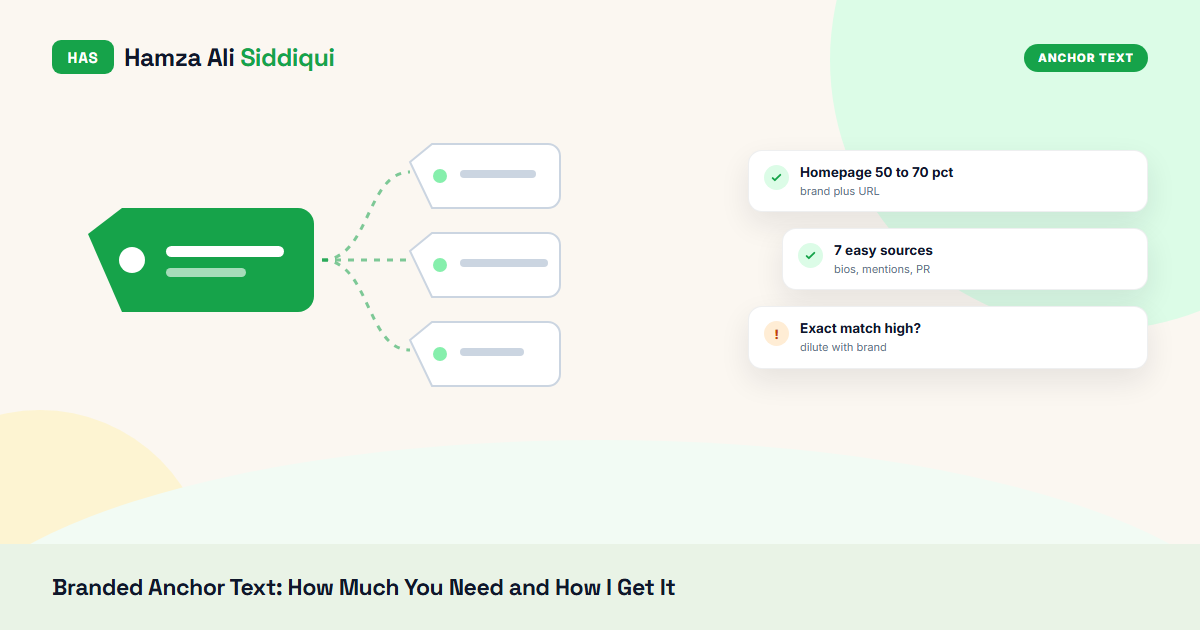
Branded anchor text is any link text that uses your brand name, your domain, or your own name instead of a keyword. “Hamza Ali Siddiqui”, “hamzaalisiddiqui.com” and “according to Ahrefs” are all branded anchors. My short answer on how much you need: for most sites, branded anchor text should be the biggest single group in your link profile, usually somewhere between a third and a half of all anchors pointing at your homepage. Below I explain why, what counts, and how I actually get publishers to use it.
I have been building links for clients since 2019, and the anchor question comes up on almost every audit call. People worry about exact match anchors (rightly), but they rarely ask the opposite question: do I have enough brand anchors to look like a normal business? That is the question this post answers.
What Counts as Branded Anchor Text (and What Does Not)
The line sounds obvious until you start tagging a real backlink export. Here is the way I classify anchors when I run a profile through the anchor text ratio checker I built for exactly this job.
| Anchor | Type | Why |
|---|---|---|
| Acme Payroll | Branded | Brand name only |
| acmepayroll.com | Naked URL (I count it with branded) | Domain, no keyword |
| Acme Payroll’s guide | Branded | Brand plus a neutral word |
| Acme payroll software | Brand + keyword | Brand name carries a money term |
| payroll software for small teams | Partial match | Keyword, no brand |
| payroll software | Exact match | The target keyword itself |
| this report | Generic | No brand, no keyword |
Branded and naked URL anchors often get lumped together because both are low risk, but tools count them separately. I cover the address-only type, with ratios and a worked example, in my guide to naked URL anchor text.
Two edge cases trip people up. The first is a brand that contains the keyword, like “Best Payroll Co”. Google can tell a business name from a phrase because the name shows up everywhere in the same form, on your site, your social profiles and your business listings. I still count those anchors as branded, but I keep an eye on them, because a profile where every anchor is “Best Payroll” reads like exact match to a tool and maybe to a reviewer too.
The second edge case is a person’s name. If you are a consultant, a founder or an author, your name is a brand anchor. Most of the links to this site use my name, and that is fine.
Why Branded Anchor Text Protects Your Rankings
Google’s spam policies on link schemes call out links with “optimized anchor text” in articles and press releases as a sign of manipulation. That single phrase explains most of my anchor rules. Natural links mostly say who you are. Bought links mostly say what you want to rank for.
Think about how real people link. A journalist writes “data from Gusto shows…” not “data from the best payroll software shows…”. A blogger recommending a tool writes the tool’s name. A forum reply pastes the URL. When I look at the profiles of well known brands in any niche, the top anchors are almost always the brand name, the domain and a few generic words. Keyword anchors sit far down the list.
So branded anchor text does three jobs for you:
- It dilutes risk. Every brand anchor makes your keyword anchors a smaller share of the whole, which is the cheapest way to fix an over-optimized profile.
- It builds entity signals. Search engines and AI tools connect your name to your topic when the two keep showing up together.
- It looks like a business. A manual reviewer who sees your brand everywhere in the anchor list has much less reason to dig.
If you already suspect you have gone too far the other way, read my guide on anchor text over optimization first, then come back here for the fix.
How Much Branded Anchor Text Do You Need?
There is no official number, and anyone who quotes you one “from Google” is guessing. What I use are working ranges I have settled on from years of audits. They depend heavily on the page type, because people link to a homepage very differently than they link to a blog post.
| Page type | Branded + naked URL | Generic | Partial match | Exact match |
|---|---|---|---|---|
| Homepage | 50 to 70 pct | 10 to 20 pct | 10 to 20 pct | Under 5 pct |
| Service or product page | 25 to 40 pct | 15 to 25 pct | 25 to 40 pct | Under 10 pct |
| Blog post or guide | 15 to 30 pct | 20 to 30 pct | 30 to 45 pct | Under 10 pct |
These are my ranges, not a law. A brand new site in a calm niche can drift outside them and be fine. A site in a spammy niche like casino or CBD should stay well inside them. The pattern that matters most: the homepage carries most of your branded anchor text, and inner pages carry more descriptive anchors. That is how links grow for real companies.
If the partial match column is the one you need to grow, I break down six safe ways to write those anchors in my post on partial match anchor text.
For the other side of this, how far you can push keyword anchors before it becomes a problem, I wrote a full breakdown on exact match anchor text.
A Worked Example: Fixing a Thin Brand Profile
This is a hypothetical example, built to show the math, not a client story. Say a payroll startup has 80 referring domains pointing at its homepage, and the anchor split looks like this:
| Anchor type | Domains now | Share now |
|---|---|---|
| Exact match (“payroll software”) | 18 | 22.5 pct |
| Partial match | 22 | 27.5 pct |
| Branded + naked URL | 24 | 30 pct |
| Generic | 16 | 20 pct |
Exact match at 22.5 pct on a homepage is the red flag. You have two levers. You can ask some publishers to change anchors, or you can add new links with brand anchors. Changing old anchors is slow and often impossible, so I lean on the second lever.
If the startup adds 40 new referring domains over the next few months, with 30 of them using the brand name or URL and 10 generic, the totals become 120 domains: 18 exact (15 pct), 22 partial (18 pct), 54 branded (45 pct), 26 generic (22 pct). Exact match is still above my homepage range, so I would also contact the 5 or 6 friendliest publishers from the exact match group and ask for a brand anchor. Getting even 6 of them to switch takes exact match down to 10 pct. That is the whole fix, and none of it needs a single risky link.
7 Ways I Earn Branded Anchor Text
Brand anchors are the easiest anchors to get, because publishers are happy to give them. You just have to stop asking for keywords. These are the sources I use, roughly from easiest to hardest.
1. Author bios on guest posts
Every guest post comes with a bio, and the bio link should almost always be your brand or your name. I save the descriptive anchor for the one contextual link inside the article body.
2. Unlinked brand mentions
When someone already wrote your name without a link, the link they add will use your name. That makes unlinked brand mentions the purest source of branded anchor text there is.
3. Data, quotes and expert comments
Journalists and bloggers credit the source by name. “A survey by Acme found…” is a brand anchor every time. This is why PR and data-led campaigns produce such clean profiles.
4. Partner, supplier and customer pages
Integration directories, “our partners” pages and case studies written by the other company list you by name. Ask your account managers who already mentions you.
5. Business profiles and listings
Crunchbase, review sites, industry associations and local chambers link with your name or URL. These links are weak on their own, but they anchor your brand entity and pad the branded share at almost no cost.
6. Podcasts and webinar guest spots
Show notes link to the guest’s company by name. One afternoon of recording can turn into a branded link that also sends real listeners.
7. Simply asking for it in outreach
When I place a niche edit or a sponsored post, I often send the anchor as “Acme Payroll” with a short reason: it fits the sentence better. Editors accept brand anchors far more often than keyword anchors, and the link survives longer because it never looked like a sale.
Brand + Keyword Anchors: The Middle Ground
“Acme payroll software” or “Hamza’s link building service” give you some relevance without the risk of a bare keyword. I use them a lot on service pages. My rule is to count them as half branded and half partial in my own sheet, and to keep them under about 15 pct of a page’s anchors. Overused, they start to look like exact match with a name stuck on the front.
For a broader view of how anchor choice fits with the link types themselves, my post on types of backlinks shows which link sources naturally carry which anchors.
Quick Branded Anchor Text Checklist
- Export referring domains with first anchor per domain, not every link (sitewide footer links distort the count).
- Split the export by target page: homepage, service pages, blog posts.
- Tag each anchor as branded, naked URL, brand + keyword, partial, exact or generic.
- Compare each page against the ranges in the table above.
- If exact match is high, plan new branded links before you touch old ones.
- Write your brand anchor variations down (name, domain, “name’s team”, “name.com blog”) so outreach does not repeat one string 50 times.
- Re-check the split every quarter, or after any campaign of 10+ links.
Mistakes I See With Branded Anchors
- Using one exact brand string for everything. Real people write “Acme”, “Acme Payroll”, “acme.com” and “the Acme blog”. Mix them.
- Pointing brand anchors at deep pages only. The homepage is where branded anchor text belongs most. A blog post with 80 pct brand anchors is odd too.
- Treating a keyword-stuffed brand name as safe. If your company is called “Cheap Backlinks Pro”, your brand anchors are keyword anchors in practice.
- Ignoring it until a penalty. Fixing a ratio with new links takes months. Balance it as you go.
- Buying directory blasts “for brand anchors”. Hundreds of junk links with your name on them are still junk links. Quality rules apply to every anchor type.
Moz has a decent primer on anchor text basics if you want a second opinion on the categories, though I find their advice light on numbers.
FAQ
What is branded anchor text in SEO?
It is clickable link text that uses your brand name, company name, personal name or domain, such as “Hamza Ali Siddiqui” or “hamzaalisiddiqui.com”, rather than a target keyword.
Is a naked URL anchor the same as a branded anchor?
Not exactly, but both say who you are without targeting a keyword, so I group them together when I check ratios. Tools like Ahrefs list them separately.
Can you have too much branded anchor text?
On a homepage, rarely. On a blog post, a profile that is almost all brand anchors can mean the page is not earning topical links, which limits how well it ranks for its keyword. Add some partial match anchors there.
Do branded anchors pass ranking value?
Yes. The link still passes authority. It passes less keyword relevance than a descriptive anchor, but the text around the link gives Google context, and Google’s own guidance on crawlable links notes that it reads surrounding text too.
How do I check my branded anchor text ratio?
Export your anchors from Ahrefs, Semrush or Search Console’s links report, then paste them into my free anchor text ratio checker. It tags each anchor and compares the split with ranges for your page type.
Where to Start
Branded anchor text is the boring part of link building, and that is exactly why it works. Pull your anchor list this week, check the homepage share first, and plan your next ten links around your name instead of your keyword. If you would rather have someone audit the profile and build the links for you, that is what my link building services cover, with every anchor planned before a single pitch goes out.