
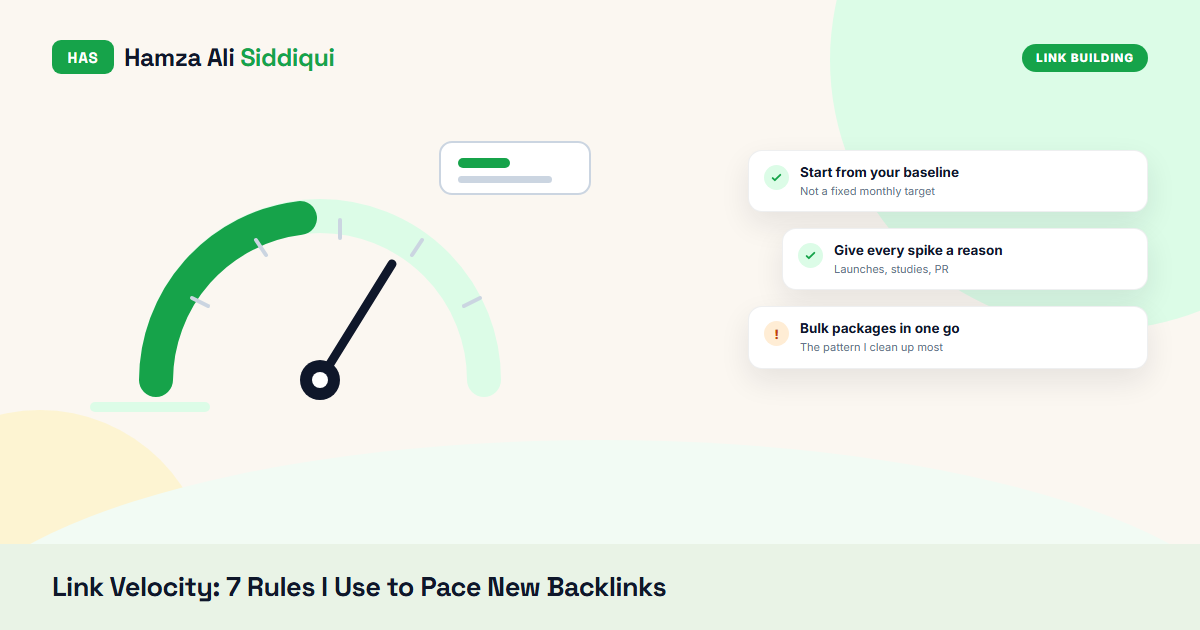
Link velocity is the speed at which a site or a single page gains new backlinks, usually counted per month. The short answer to the question everyone asks me (“how many links a month is safe?”) is that there is no fixed safe number. What matters is whether your link velocity looks like something real people would cause, given your site’s age, your niche and what you actually published. A sudden spike of links nobody had a reason to give is the problem, not the number itself.
I have been building links since 2019, and pacing comes up in almost every first call with a new client. So here are the seven rules I use to plan a link building pace, how I track it, and the mistakes that make people nervous for no reason (and the few that should make them nervous).
What link velocity actually measures
Most SEO tools show two lines on a chart: new referring domains and lost referring domains over time. The gap between those lines is your net growth. When people talk about link velocity they usually mean the “new” line, but I care about both. A site that gains 20 domains a month and loses 18 is not growing at all, whatever the first number says.
I also count referring domains, not total backlinks. One sitewide footer link can show up as thousands of backlinks from a single domain. That inflates the chart and tells you nothing. Ten new domains, each linking once from a real article, is the kind of growth I want to see.
Does Google really look at link velocity?
Google has never published a “links per month” limit, and I do not trust anyone who quotes one. What we do know is that Google has long thought about link growth over time. Its patent on information retrieval based on historical data describes looking at how fast a document gains links, and treating a sudden jump with suspicion when it does not fit the document’s history. A patent is not proof of a ranking factor, but it shows the thinking.
The part that is not up for debate is Google’s link spam policy. Buying links that pass ranking credit, large-scale exchanges and automated link creation are all listed. Fast link velocity is not against the rules. But a fast pace built from paid or automated links is exactly the pattern that makes those links easy to spot. In my view, speed is rarely the cause of trouble. It is the thing that makes the cause visible.
My 7 rules for a safe link velocity
1. Start from your current baseline, not a target
Before I plan anything I pull the last 12 months of new referring domains for the site. If a store has been gaining two or three domains a month on its own, jumping to 40 next month looks odd. Jumping to six or eight does not. My first month is usually somewhere around double the natural baseline, then I adjust.
2. Match the pace to site age and size
A three-month-old blog and a ten-year-old brand can both build links, but they cannot build them at the same speed and look natural. Older sites with lots of content and existing mentions have more reasons to attract links, so they can absorb a faster pace. The table further down shows the ranges I start from.
3. Give every spike a reason
Spikes are fine when something caused them. A data study, a product launch, a podcast tour or a digital PR story can earn dozens of links in a week, and that is completely normal. Real spikes come with traffic, brand searches and social mentions. A spike of 30 guest posts on unrelated blogs with nothing else happening has no story behind it, and that is the one I avoid.
4. Keep a steady floor instead of bursts
I would rather build 8 links every month for a year than 50 in January and nothing until summer. A steady line is easier to defend, easier to measure and easier to budget. It also stops the classic pattern where a client buys a big package, sees the links land, then panics when rankings move around for a few weeks.
5. Spread links across pages
Link velocity applies to single pages too. If every new link points at one money page, that page’s growth looks forced even when the site-wide pace is modest. I split links between the homepage, key category or service pages and the blog posts people actually like to cite. A rough starting split I use is one third to the homepage and brand, one third to commercial pages, and one third to content.
6. Watch anchors at the same time
Fast growth plus exact-match anchors is the combination that gets sites in trouble. When I speed up, I make the anchor mix more conservative: more branded, more naked URLs, more natural phrases. I wrote about this in detail in my guide to anchor text over optimization, and you can test your own mix with my free anchor text ratio checker.
7. Judge quality before speed
Five links from real sites in your niche beat 25 from a network of thin blogs, at any pace. If I have to choose between hitting a monthly number and keeping quality, the number loses every time. A slower link velocity from relevant pages is still progress. A fast one from junk is just future cleanup work, the kind I describe in my post on toxic backlinks.
Link velocity starting ranges I use
These are my own planning ranges, not rules from Google. They are starting points for new referring domains per month from active outreach, before anything earned naturally. I adjust them after the first two or three months based on what the site’s own baseline and rankings tell me.
| Site situation | Built links per month (start) | What I watch |
|---|---|---|
| New site, under 6 months, few pages | 2 to 5 | Indexing of the links, branded anchors only at first |
| Young site, 6 to 18 months, regular content | 5 to 10 | Which pages earn links on their own |
| Established site, 2+ years, steady traffic | 10 to 20 | Anchor mix and net growth after losses |
| Large brand or store with PR activity | 20+ | Spikes lined up with campaigns and launches |
| Recovering from a penalty or cleanup | Slow, 2 to 5 | Only clearly editorial links, nothing paid |
Here is a hypothetical example of how I use the table. Say a SaaS blog is 14 months old and has gained around three referring domains a month on its own. It sits in the second row, so I would plan 6 links in month one, 8 in month two and 10 by month three, then hold there while I check rankings and losses. If the site launches a free tool in month four and it gets picked up, a jump to 25 that month is fine because there is a clear reason for it.
How I track link velocity every month
- Export new and lost referring domains for the last 30 days from Ahrefs, Semrush or the free Search Console Links report. My guide on how to check backlinks walks through the free options.
- Remove sitewide and obvious spam domains so they do not distort the count.
- Write down net new domains (new minus lost) in a simple sheet, one row per month.
- Tag each built link with the target page and anchor type.
- Compare the line with traffic and rankings for the pages that got links.
- Decide next month’s pace: hold, speed up a little, or slow down.
That whole routine takes me about 30 minutes per site. The sheet matters more than the tool. After six months you can see your own pattern, which is far more useful than any generic advice about link velocity, including mine.
Quick checklist before you speed up
- Do I know my natural monthly baseline from the last 12 months?
- Is the new pace no more than about double that baseline for a young site?
- Are the new links spread across at least three different pages?
- Is the anchor mix mostly branded, URL and natural phrases?
- Do the linking sites have real traffic and topics close to mine?
- If there is a spike coming, is there a launch, study or story behind it?
- Am I tracking lost links too, not just new ones?
Common link velocity mistakes
Buying a big package in one go. Fifty links delivered in two weeks to a site that never had more than a handful is the most common pattern I clean up. If you buy links in bulk, ask for them to be delivered over several months. I explain why in my post on link building cost, where spreading the budget also makes it easier to judge results.
Stopping completely after a push. A sharp rise followed by a flat line for a year looks like a campaign, not a business people talk about. Keep a small, steady floor even when budgets are tight.
Panicking over a natural spike. If a post goes viral and earns links fast, do not disavow them or ask sites to remove them. That is the best kind of link velocity there is.
Expecting faster pace to mean faster rankings. Links take time to be crawled and counted. Doubling your pace does not halve the wait. I cover realistic timelines in how long backlinks take to work.
Ignoring lost links. If you lose as many domains as you gain, your real growth is zero. Chase the lost ones that matter before buying new ones.
Link velocity FAQ
What is a good link velocity?
One that fits your site. For a young site that might be 5 to 10 new referring domains a month from outreach. For an established brand it can be much higher. The key is that growth looks steady and every big jump has a reason behind it.
Can too many backlinks too fast hurt my site?
Speed on its own rarely causes a penalty. The risk comes when a fast pace is made of paid, swapped or automated links, because the spike makes that pattern easy to notice. Fast growth from real coverage is normal.
How many backlinks should I build per month for a new site?
I usually start new sites at 2 to 5 built links a month, with branded or URL anchors, and increase slowly once the site has more content and starts earning links on its own.
Does link velocity apply to single pages?
Yes. A page that suddenly gains many links while the rest of the site gains none can look forced. Spread links across the homepage, commercial pages and content.
How do I check my link velocity for free?
Use the Links report in Google Search Console or Ahrefs Webmaster Tools, export referring domains each month, and track new minus lost domains in a spreadsheet.
Pace beats pressure
Good link velocity is boring on purpose: a steady floor of relevant links, spikes only when something real happens, and an anchor mix that stays calm when the pace goes up. Know your baseline, grow from it, and track losses as closely as gains. If you would rather have someone plan and build that pace for you, my link building services page explains how I work and what a monthly plan looks like.