
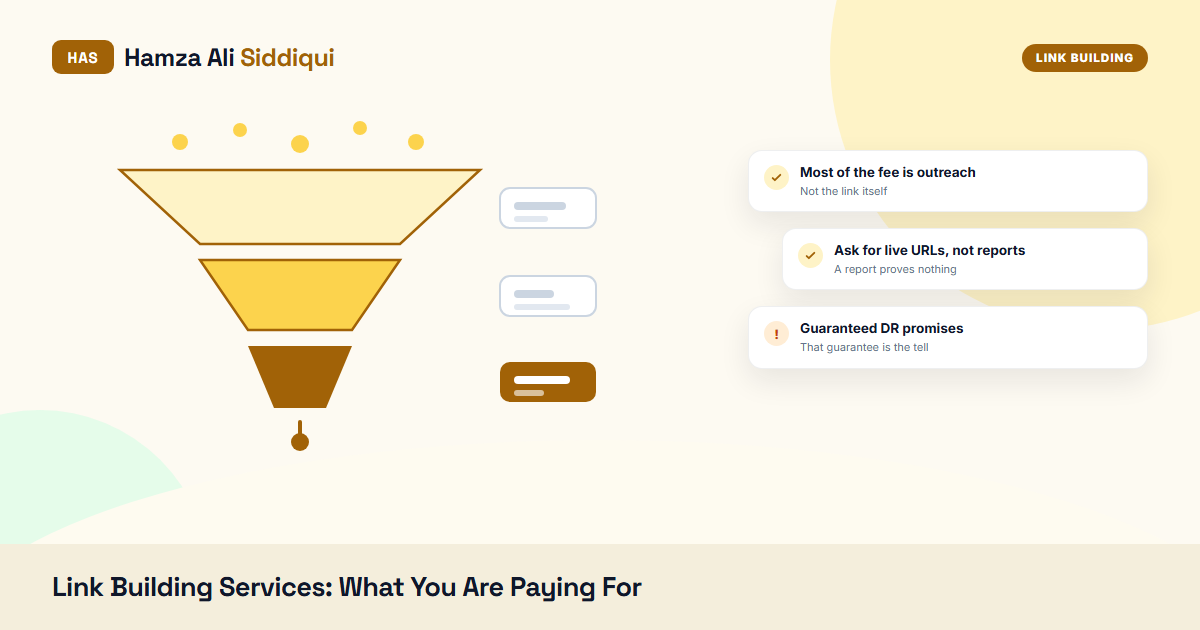
Type “link building services” into Google and you get two hundred agencies promising “high DA backlinks”, a spreadsheet of sites they will sell you a link on, and almost nothing that explains what you are actually buying. After running link building for clients across a dozen niches, I can tell you the difference between a good service and a bad one is not the price. It is whether the links would exist if nobody had paid for them.
This guide explains what link building services actually deliver, what each type costs in 2026, how to read a proposal, the red flags that mean walk away, and how to decide between an agency, a freelancer and doing it in-house. Read it before you sign anything.
What a link building service actually does (and what it does not)
A genuine link building service does four things: it finds websites in your niche that could plausibly link to you, it creates a reason for them to do so (an article, a data point, an expert quote, a resource), it handles the outreach and negotiation, and it reports every link that goes live with the URL, anchor text and the metrics of the linking page. Everything else, the “DA 50+ guaranteed” packages, the 100-links-for-99-dollars offers, the networks of sites that all look the same, is not link building. It is link selling, and Google’s spam team has spent a decade learning to recognise it.
The service does not control rankings, and anyone who guarantees a position is lying to you. What a good service controls is the quality, relevance and pace of the links, which is what rankings respond to over time.
Whatever provider you pick, keep an eye on the anchors they use. My free anchor text ratio checker shows the exact-match share in one click, and the rest of my free SEO tools are on one page.
The seven types of link building services, and what each one is worth
1. Guest posting services
The service writes an article for a third-party site and places one or two links back to you inside it. Done properly, on sites with real readers, this remains one of the most reliable ways to build authority and it is what most agencies mean by “link building”. Done badly, on sites that publish eight guest posts a day, it is a link farm with better branding. Expect 150 to 600 dollars per placement on genuine DR 30 to 60 sites, including writing. My full process is in the guest posting guide.
2. Link insertions (niche edits)
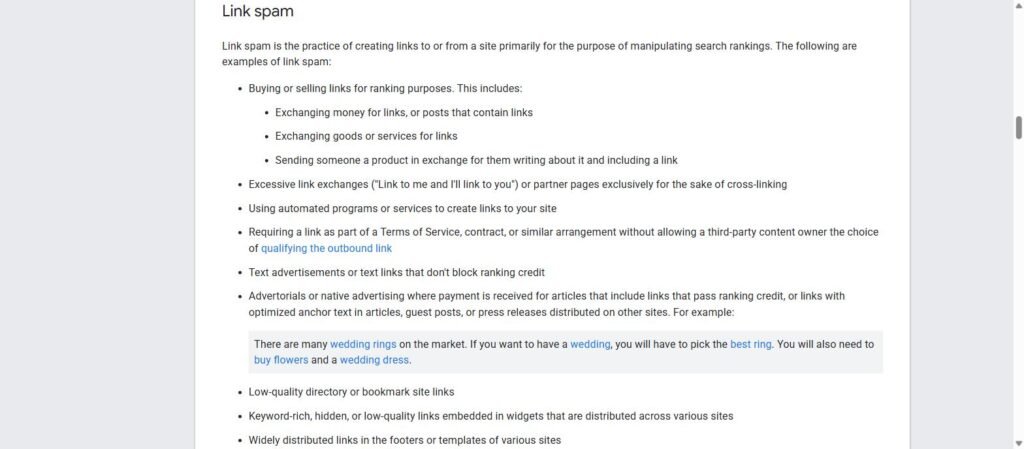
Instead of a new article, the service gets your link added to an existing, already-ranking page on a relevant site. Faster than guest posts and often more powerful, because the page already has age and traffic. Typical cost is 80 to 400 dollars per link for DR 30 to 60. Vetting matters more here than anywhere: the same tactic on a site that sells insertions openly is exactly what Google’s link spam policy describes. See how link insertions work.
3. Digital PR
The service creates something newsworthy, usually original data, a study or a strong expert angle, and pitches it to journalists. Links come from news sites and major publications, are almost never for sale, and carry the most weight of anything on this list. It is also the most expensive and least predictable: retainers start around 3,000 to 5,000 dollars a month and a campaign can produce two links or twenty.
4. HARO and expert-quote services
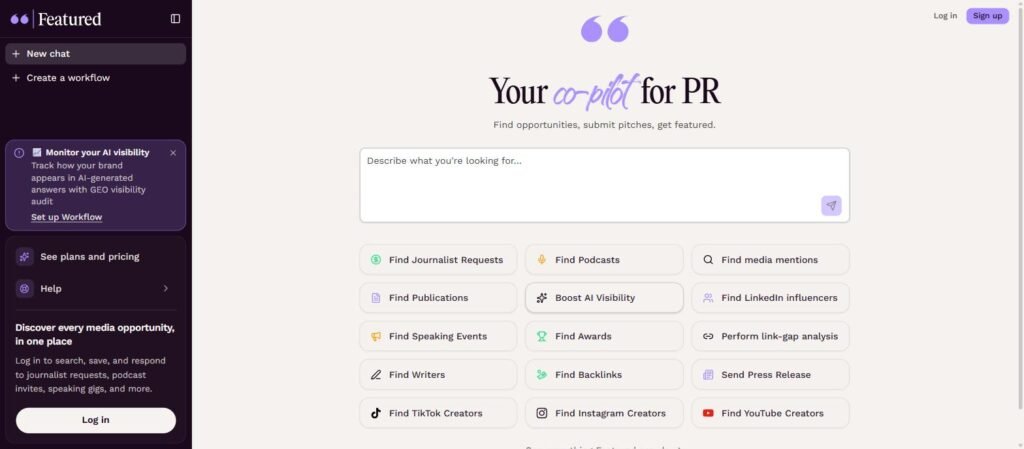
Journalists post requests for expert sources; the service answers them on your behalf and earns a link when your quote is used. Cheap per link when it works (often 100 to 300 dollars effective cost), but success rates are low and the quotes have to genuinely come from you or someone credible at your company. Platforms like Featured, Qwoted and Help a B2B Writer have replaced the original HARO.
5. Blogger outreach
Broad outreach to bloggers in your niche for reviews, mentions, roundups and collaborations. Sits between guest posting and PR. Quality varies enormously by agency, because “blogger” can mean a respected niche publication or a site that exists to sell sponsored posts.
6. Broken link and resource page building
The service finds dead links on relevant pages and resource lists, then pitches your content as the replacement. Slow, entirely white-hat, and the links are genuinely editorial. Usually sold inside a monthly retainer rather than per link, because the yield is unpredictable.
7. White-label link building
An agency builds links that another agency resells to its own clients under its brand. Nothing wrong with the model, but it adds a margin and a layer between you and the person doing the work. If your marketing agency offers “link building”, ask who actually does it.
Link building service prices in 2026
These are the ranges I see from genuine providers on real sites. Anything dramatically cheaper is almost always a network, and anything dramatically more expensive should come with a named strategist and PR-level results.
If you are comparing fixed monthly offers, I broke down what link building packages include at each price tier, with a real two-quote teardown from one of my clients.
For a per-link and per-hour view of these prices, with a worked in-house example and a 5-step budget method, see my guide to link building cost.
| Service type | Typical 2026 price | Time to first link | Risk if done badly | Best for |
|---|---|---|---|---|
| Guest posting | 150 to 600 dollars per link + writing | 2 to 6 weeks | Medium | Building topical authority |
| Link insertions | 80 to 400 dollars per link | 1 to 3 days | Medium to high | Pushing money pages fast |
| Digital PR | 3,000 to 10,000 dollars per month | 4 to 12 weeks | Low | Brands with a story or data |
| HARO / expert quotes | 500 to 2,000 dollars per month | 2 to 8 weeks | Low | Founders with real expertise |
| Blogger outreach | 1,500 to 5,000 dollars per month | 2 to 6 weeks | Medium | Consumer and lifestyle niches |
| Broken link / resource pages | Inside a retainer | 4 to 10 weeks | Very low | Sites with strong guides |
| White-label | Reseller margin of 20 to 50 percent | Varies | Depends on the supplier | Agencies without an in-house team |
How services price their work, and what each model rewards
- Per link. Simple and transparent, but it rewards volume over quality. Insist on approving every site before payment.
- Monthly retainer. Better for PR, broken link building and anything with unpredictable yield. Ask for a minimum deliverable and a monthly report.
- Performance-based. Pay per live link that meets agreed criteria (minimum traffic, relevance, do-follow). The fairest model when the criteria are strict.
- Packages by DA tier. “10 DA 40+ links for 1,500 dollars.” This is the pricing model of link networks. Domain Authority is trivially inflated, and no genuine editorial process produces a fixed number of links at a fixed metric on a fixed date.
What a good link building service actually delivers
- A prospect list you approve before any outreach starts, with the linking page’s traffic, not just the domain metric.
- Contextual, do-follow links placed in the body of relevant content, with natural anchor text you have agreed.
- A live report for every link: linking URL, target URL, anchor, date, DR, page traffic and a screenshot.
- A replacement guarantee if a link is removed or switched to nofollow within a set period, usually 6 to 12 months.
- A written policy that they do not use PBNs, link farms or sitewide placements.
- Monthly reporting against the metrics that matter: referring domains gained, rankings for target keywords, organic traffic to target pages.
Red flags in a link building proposal
- Guaranteed rankings or a guaranteed number of links per month at a fixed DA.
- A price list by DA or DR tier. Metrics are easy to fake; traffic is not.
- “We have relationships with 5,000 publishers.” That is a network, and every one of your competitors has been offered the same sites.
- No site approval before placement.
- Exact-match anchor text as the default.
- Links that are “rented” for 12 months instead of permanent.
- No mention of what happens if a link is removed.
- Prices well under 100 dollars per link on supposedly DR 50+ sites.
- Sponsored links sold as editorial ones with no disclosure discussion.
Agency vs freelancer vs in-house vs doing it yourself
| Option | Monthly cost | Strengths | Weaknesses | Choose it when |
|---|---|---|---|---|
| Specialist agency | 2,000 to 10,000+ dollars | Process, capacity, PR reach, reporting | Cost, less control, possible white-labelling | You need 10+ quality links a month or PR |
| Freelance specialist | 800 to 3,000 dollars | Direct access, flexibility, often deeper niche knowledge | Limited capacity, single point of failure | You want 3 to 8 vetted links a month with full transparency |
| In-house | Salary plus tools (300 to 500 dollars per month) | Full control, brand knowledge, compounding relationships | Slow to start, needs training and tools | Link building is a permanent priority |
| Do it yourself | Tools and your time | Free, you learn what works | Time-consuming, steep learning curve | Early stage, small budget, one priority page |
Ten questions to ask before you sign
- Which specific sites did you place links on last month for a client in a similar niche, and can I see them?
- Do I approve every site before outreach?
- What is the minimum organic traffic for a linking page?
- Who writes the content, and can I review it?
- What anchor text policy do you follow?
- Are links permanent? What is the replacement policy?
- Do you use PBNs, marketplaces or sites you own? (Ask it directly and watch the answer.)
- What does the monthly report contain?
- Who is my point of contact and how often do we speak?
- What results should I realistically expect at 90 days, and what would make you recommend I stop?
How to measure whether the service is working
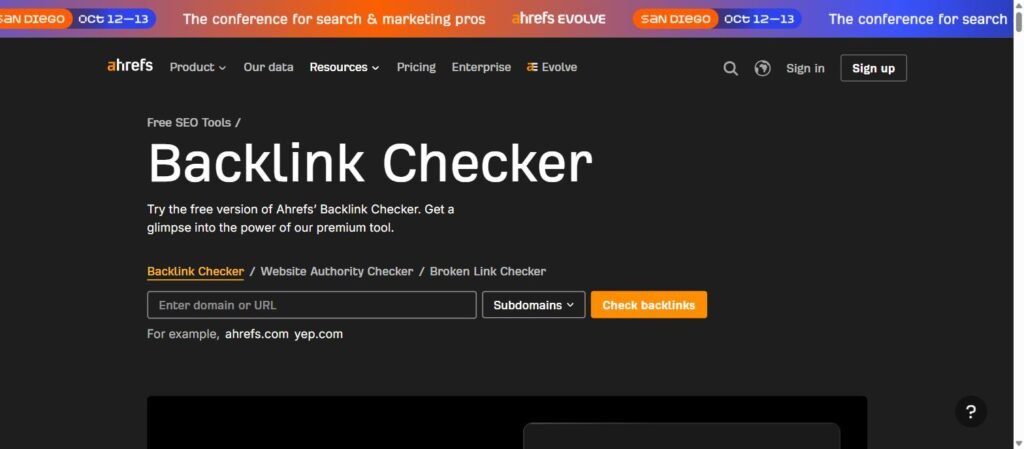
Judge a link building service on three numbers, in this order. Referring domains to your target pages, which should climb steadily from month one. Rankings for your target keywords, which usually start moving between weeks six and twelve. Organic traffic and leads to the target pages, which follow rankings. Check the links yourself with a backlink checker at 30 and 90 days, because links do get removed, and make sure the pages you are pointing at have their on-page SEO in order, or you will blame the links for a problem they did not cause.
If you have already decided to hand the work over, my step-by-step guide on how to outsource link building has the brief I send vendors, a 30-day trial plan and a 20-point vendor scorecard.
A realistic 90-day plan for a small business
- Weeks 1 to 2. Choose three to five priority pages. Run a backlink gap analysis against your top competitors. Reclaim any unlinked brand mentions.
- Weeks 3 to 6. Two to three link insertions on aged, relevant pages per priority page. One guest post on a site your customers read.
- Weeks 7 to 12. Keep the cadence at four to six quality links a month. Start one digital PR or expert-quote angle if you have a story. Re-verify every link at day 30 and 90.
- Budget. 1,500 to 3,000 dollars a month buys this honestly. Below that, you are buying from a network whether you realise it or not.
How to audit a provider’s past work in twenty minutes
Every agency will show you a case study. Very few will show you the actual links, so ask for five live placements from the last sixty days for a client in a niche like yours. Then run this check before the sales call ends.
- Open each linking page. Is it a real article on a real site, or a thin post surrounded by other paid links? Count the outbound links to unrelated businesses.
- Check page traffic, not domain metrics. Put the exact URL into Ahrefs or Semrush. A DR 55 site can have a linking page with zero visits.
- Look at the anchor. If all five links use exact-match commercial anchors, that is the pattern Google’s link spam systems flag.
- Search the site’s name plus “sponsored post” or “write for us”. If it sells placements openly, the agency is reselling inventory, not doing outreach.
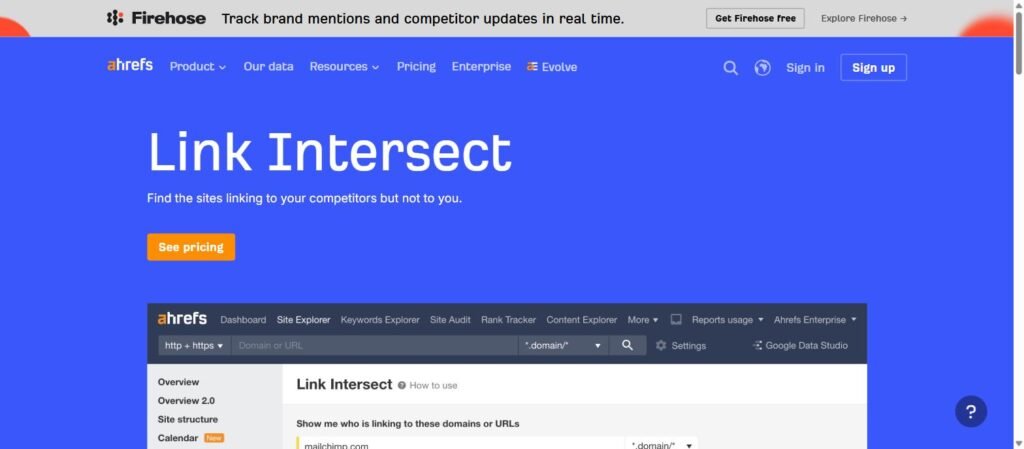
- Run the domain through a link intersect tool. If the same site links to twenty competing agencies’ clients, it is a shared network, and your competitors already have the same link.
What a proper link report looks like
A monthly report from a genuine service is boring in a good way: it lists every link with enough detail for you to verify it yourself. If a report only gives you counts and a Domain Authority average, you are being managed, not informed. Here is the minimum you should receive for each link.
| Field | Why it matters |
|---|---|
| Linking page URL and date live | So you can open it and confirm the link exists |
| Target URL and anchor text | So you can check anchor distribution across the campaign |
| Link type (guest post, insertion, PR, mention) | Different types carry different risk and value |
| Do-follow status | Nofollow or sponsored links should be flagged, not hidden in the count |
| Linking page organic traffic | The single best proxy for whether the link passes anything |
| Domain traffic and DR or DA | Context, not the headline metric |
| Screenshot | Evidence the link was placed in the body, not a footer or author box |
| Status at 30 and 90 days | Links get removed or switched to nofollow; a good service re-checks |
Contract terms worth insisting on
- Site approval before outreach, with the right to reject any prospect without penalty.
- Minimum linking-page traffic written into the agreement, not just a DR floor.
- Permanent placements. A “12-month rental” clause means your rankings are on a subscription.
- Replacement of any link removed or changed to nofollow within twelve months.
- An explicit ban on PBNs, sitewide links, link farms and sites the provider owns.
- Anchor text policy agreed in writing, with exact-match anchors capped.
- Monthly reporting in the format above, plus raw data you can export.
- A 30-day exit clause. Good providers do not need to lock you in.
Link building services by niche: what changes
SaaS and B2B
Buyers research heavily, so guides, comparison pages and original data earn links naturally when promoted. Expect higher prices (SaaS is one of the most competitive niches for placements) and lean on digital PR, expert quotes and data-led guest posts. Integration and partner pages are an underused source of relevant, editorial links.
Local businesses
You need fewer links, but they must be local and relevant: chambers of commerce, local news, sponsorships, suppliers, community organisations and local directories with real traffic. A local business with fifteen genuinely local links will outrank one with a hundred generic guest posts.
Ecommerce
Product pages rarely earn links on their own. Build them to category and guide pages instead, then pass authority internally with a solid internal linking strategy. Gift guides, product roundups and supplier or manufacturer pages are the most productive targets.
Finance, health and legal
The highest scrutiny and the highest prices. Google’s quality standards for these topics mean links from low-quality sites can actively hurt. Prioritise expert quotes, PR, professional associations and genuinely authoritative publications, and expect to pay two to three times the general-niche rates.
A worked example: what 2,500 dollars a month should buy
Take a small B2B services company with three priority pages and a 2,500 dollar monthly budget. A realistic month from an honest provider looks like this: two link insertions on aged, relevant articles with real traffic (roughly 250 dollars each), two guest posts on industry publications the company’s customers read (roughly 400 dollars each including writing), one expert-quote placement earned through journalist request platforms (roughly 300 dollars of effort), a monthly unlinked-mention sweep that usually recovers one or two links for free, and the time to prospect, pitch, negotiate, verify and report on all of it. That is five to seven high-quality referring domains a month. Over six months it is thirty to forty links that would survive any review, which for most small businesses is the difference between page two and the top five.
Compare that with the “50 DA 40+ links for 2,500 dollars” package. Fifty links in a month from a fixed inventory is fifty links that hundreds of other clients also have, on sites Google has probably already discounted. Same money, opposite outcome.
Frequently asked questions about link building services
Are link building services worth it?
Yes, when the service builds links that would survive a Google review and points them at pages that deserve to rank. Backlinks remain one of the strongest ranking factors, and most businesses do not have the time or contacts to earn them alone.
How much should I pay for link building?
Budget 100 to 400 dollars per genuine link, or 1,500 to 5,000 dollars a month for a managed campaign. If a quote is far below that, ask how they are producing links so cheaply. The answer is almost always a network.
Is buying links from a service against Google’s guidelines?
Paying for links that pass ranking signals is against Google’s spam policies. In practice the risk sits with obvious, low-quality, high-volume placements. Reputable services build links that are editorially justified, on real sites, with natural anchors. Understand the risk and keep quality high.
How long until link building shows results?
Typically six to twelve weeks for the first ranking movement, and three to six months for a campaign to show clearly in traffic. Anyone promising results in two weeks is either manipulating metrics or measuring the wrong thing.
What is the difference between link building and PR?
Digital PR earns links by making your brand newsworthy; link building places links through outreach and content. PR links are stronger and harder to get. Most good campaigns use both.
Can I do link building myself?
Yes, especially for a small site with one or two priority pages. Start with unlinked mentions and link insertions, and read the guides on this blog. Hire when your time is worth more than the links are costing you.
Next step
Before you talk to any provider, write down your three priority pages, your monthly budget and the answer you expect to the ten questions above. That alone will filter out most bad proposals. If you would like a link building service that shows you every site before outreach and reports every link with traffic, not just a DA number, have a look at my SEO services or get in touch.