
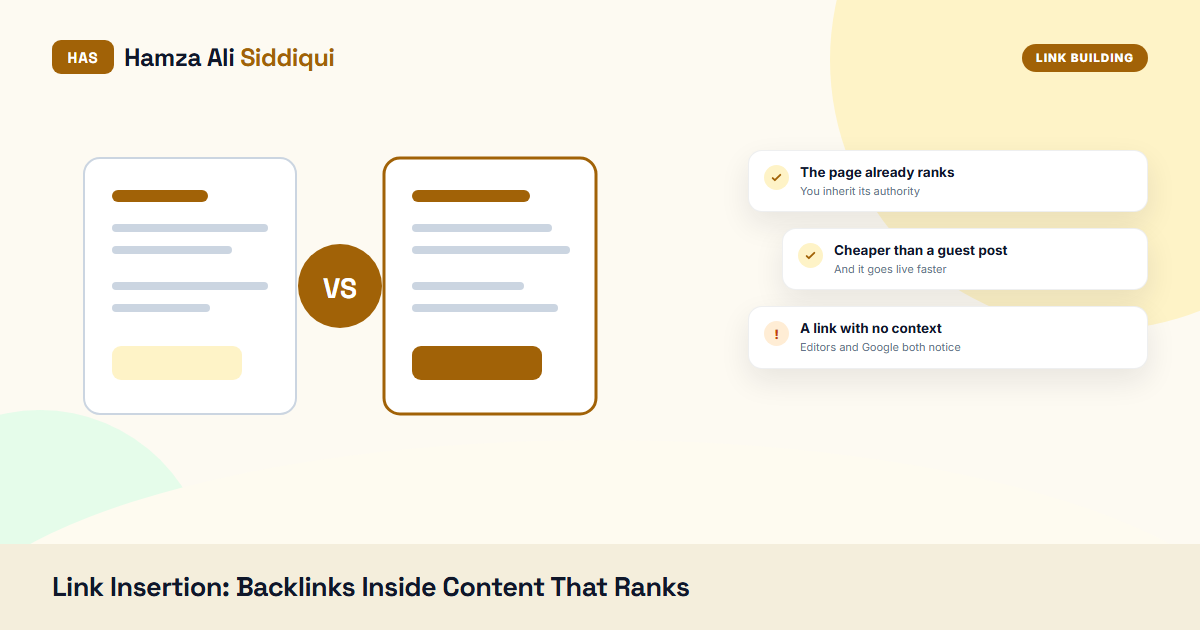
Link insertion (you will also hear it called a niche edit or a curated link) is when a site owner adds a link to your page inside an article that is already published and, ideally, already ranking. No new content to write, no waiting weeks for a guest post to get indexed. The page already has age, authority and traffic, and your link starts borrowing all three the day it goes live. It is one of the fastest-moving tactics in my off-page SEO work for clients, and also one of the easiest to get badly wrong.
This guide covers exactly how I find, qualify, pitch and verify link insertions in 2026, the prices you should expect, and the red flags that turn a “cheap DR 60 link” into a problem you have to disavow six months later.
What link insertion actually is (and what it isn’t)
A proper link insertion is a contextual, do-follow link placed inside the body of an existing, indexed article on a real website, in a sentence where it genuinely adds something for the reader. The surrounding paragraph is about your topic, the page has organic traffic, and the link looks like the editor put it there because it belonged.
People who buy these placements usually compare them with guest posts before spending anything, so I wrote a full breakdown of niche edits vs guest post costs, turnaround and risk.
What it is not: a link dropped into a “useful resources” list with 80 other URLs, a footer or sidebar link, a link on a page that nobody has visited since 2019, or a placement on a site whose entire business model is selling links. Those are still links. They are just not the kind that move rankings, and some of them actively work against you.
Before you pay for any placement, it is worth reading what I found about the real cost and risk of the market in my guide to buying backlinks for SEO.
Why link insertions work so well in 2026
- The page is already trusted. An article that has been indexed for two years and ranks for its own keywords has already passed every quality check Google runs on new content. Your link inherits that trust immediately.
- Topical relevance is built in. Because you choose a page that is already about your subject, the link sits in the most relevant context possible, which is exactly what Google’s link evaluation rewards.
- Speed. A guest post takes writing, editing, publishing and indexing. A link insertion can be live in 48 hours, and in my client campaigns a link on a page that already ranks on page one typically shows movement in three to six weeks, against two to three months for a fresh guest post.
- It looks natural. Editors update old articles all the time. A single relevant link added to an aged post is one of the most normal patterns on the web, which is why it survived every link spam update while obvious schemes did not.
How to find link insertion opportunities, step by step
This is the exact process I run. The order matters: qualifying before pitching saves you from paying for links you later regret.
1. Start with pages that already rank for related terms
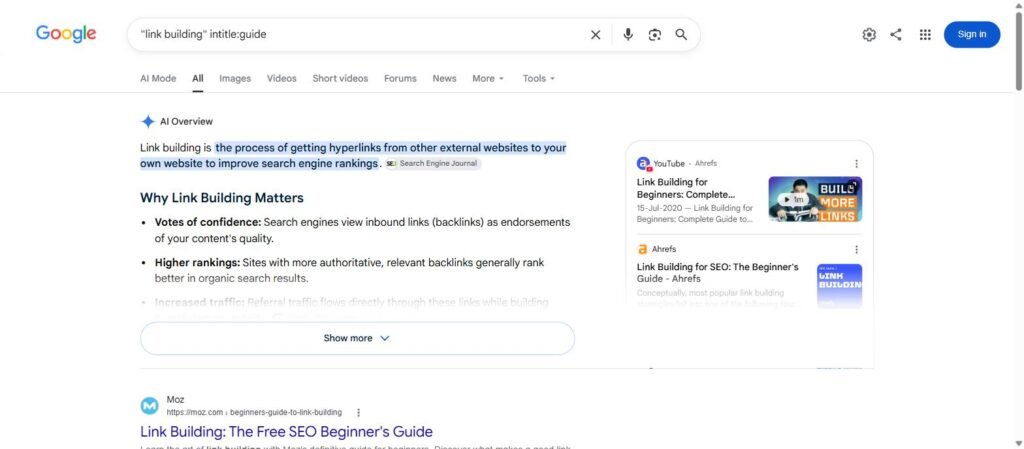
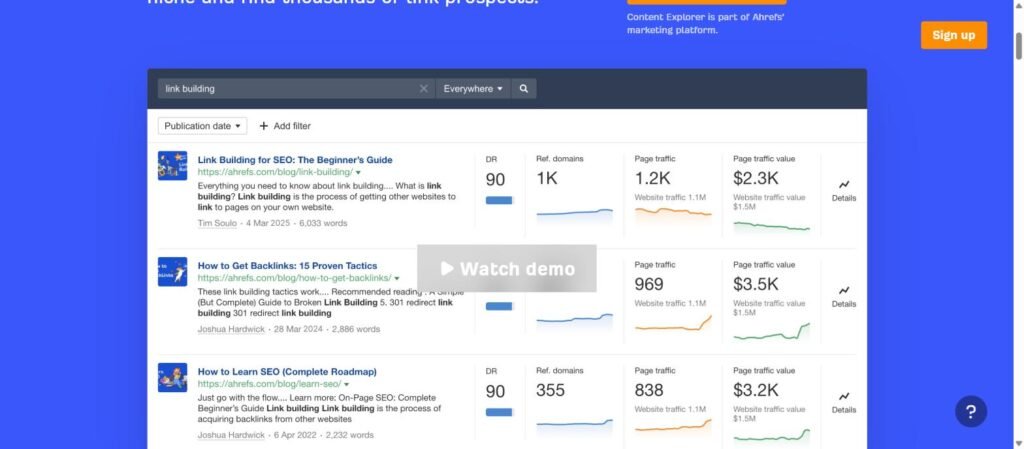
You want articles on your topic that are already visible in search. Use simple operators like “your topic” intitle:guide or “your topic” inurl:blog, then run the same topic through Ahrefs Content Explorer or Semrush with filters for Domain Rating 30 and above, at least 500 monthly organic visits, and a publish date older than twelve months. Aged pages are the ones worth inserting into.
2. Check the page itself gets traffic, not just the domain
Domain-level metrics are where most people stop, and it is where most bad decisions happen. A DR 55 site can have an article with zero organic visits. Look at the URL-level traffic in Ahrefs or Semrush. If the specific page you want a link on gets nothing, the link is worth far less than the seller will tell you. I skip any page under roughly 100 monthly organic visits unless the site is exceptionally relevant.
3. Find the exact sentence where your link belongs
Read the article. Find the paragraph that discusses what your page covers, and write the sentence you want added, with your anchor text in place. Editors say yes far more often when you have done the work for them, and it stops them dropping your link somewhere irrelevant.
A link added this way is one of the cleanest contextual backlinks you can get, because the words around it already match your topic.
4. Qualify the site before you contact anyone
- Fewer than 15 to 20 external links on the target page. Beyond that, each link passes very little.
- No links to casino, crypto, essay-writing, CBD or pharma sites unless the site is actually in that niche.
- Organic traffic that is flat or growing over the last six months. A steep decline usually means a penalty or a core update hit.
- The page is indexed. Search the exact URL in Google. If it does not appear, walk away.
- Real content by real people. If every post reads like unedited AI output, the site is probably a link farm in the making.
5. Find the right person to email
The author of the article or the content editor, not the generic contact form. Hunter, the site’s about page and LinkedIn usually get you there in a couple of minutes. A pitch to a named person who owns that article converts several times better than one to info@.
6. Pitch short, specific and useful
Four or five lines. Name the article, quote the sentence you want to update, show the addition, and give a reason the link helps their reader: a newer statistic, a step their piece skips, a tool their audience needs. Never open with “I would like to buy a link”. If money comes up, let them raise it, and be clear from the start that you only place do-follow, permanent links.
7. Negotiate and get the terms in writing
In 2026, genuine sites with DR 30 to 60 and real traffic charge roughly 80 to 400 dollars for an insertion in most niches, with finance, health, legal and SaaS considerably higher. Anything well below that range on a supposedly strong site is almost always a link farm. Before you pay, confirm in writing: do-follow, permanent (not a twelve-month rental), your anchor text as written, placed in the body, and no “sponsored” label unless you have agreed to disclose it.
8. Verify after it goes live, then again at 30 and 90 days
Open the page, view the source, and confirm the link is there, is do-follow, points to the right URL and is not hidden in a collapsed block. Then check it is still live at 30 and 90 days. Links get quietly removed, switched to nofollow or redirected more often than anyone admits. My guide on how to check SEO backlinks walks through the exact checks.
Choosing anchor text that won’t get you flagged
The fastest way to turn good link insertions into a manual action is to make every anchor your exact target keyword. Keep exact-match anchors to a small minority of your profile, well under 15 percent, and build the rest from partial-match phrases, branded anchors, page titles and the occasional naked URL. The single best test is whether the sentence would still read naturally if the link was removed. If the anchor only exists to carry a keyword, rewrite it.
If your profile is already skewed, I walked through how I diagnose and fix anchor text over optimization, including the ranges I treat as safe and the order I apply the fixes.
Link insertion vs guest posting: which should you use?
| Factor | Link insertion | Guest post |
|---|---|---|
| Time until live | 1 to 3 days | 2 to 6 weeks |
| Authority of the page | Aged, already ranking | New, starts from zero |
| Content effort | One sentence | Full 1,000+ word article |
| Control over context | Limited to the existing article | Full control |
| Typical cost (DR 30 to 60) | 80 to 400 dollars | 150 to 600 dollars plus writing |
| Best for | Pushing money pages that need relevant authority fast | Building topical authority, brand and relationships |
My rule is simple. When an aged, relevant, trafficked page exists, a link insertion is usually the better buy for a commercial page. When you need to establish your brand in a niche, or the topic has no strong existing articles to insert into, write the guest post. Most of my client campaigns use both, roughly two insertions for every guest post.
Red flags: link insertions that will hurt you
- A public “advertise with us” page listing link prices. Google’s team can read that page too.
- Articles that have been edited dozens of times, each time gaining a new external link to an unrelated business.
- A DR 70 site offering insertions for 50 dollars. Real authority does not sell that cheaply.
- Sitewide organic traffic down 40 percent or more in the last year.
- Your link ends up marked nofollow or sponsored after you have paid for do-follow, or inside a “Partner content” box.
- The seller offers you a list of 200 sites in a spreadsheet. That is a network, and you do not want your money page anywhere near it.
How to measure whether a link insertion worked
Do not judge a single link in isolation. Track the target page in Google Search Console and compare impressions and average position for its main queries at four, eight and twelve weeks after the link goes live. Confirm the referring domain shows up in Ahrefs or Semrush within a couple of weeks, which tells you the page was recrawled. If the linking page itself climbs after the update, even better, because a stronger source passes more. And make sure your own page is not the bottleneck: a solid link into a page with weak on-page SEO will always underperform.
Frequently asked questions about link insertion
Is link insertion the same as a niche edit?
Yes. Niche edit, curated link, contextual link placement and link insertion all describe adding a link to an existing published article. The terms are used interchangeably across the industry.
Are paid link insertions against Google’s guidelines?
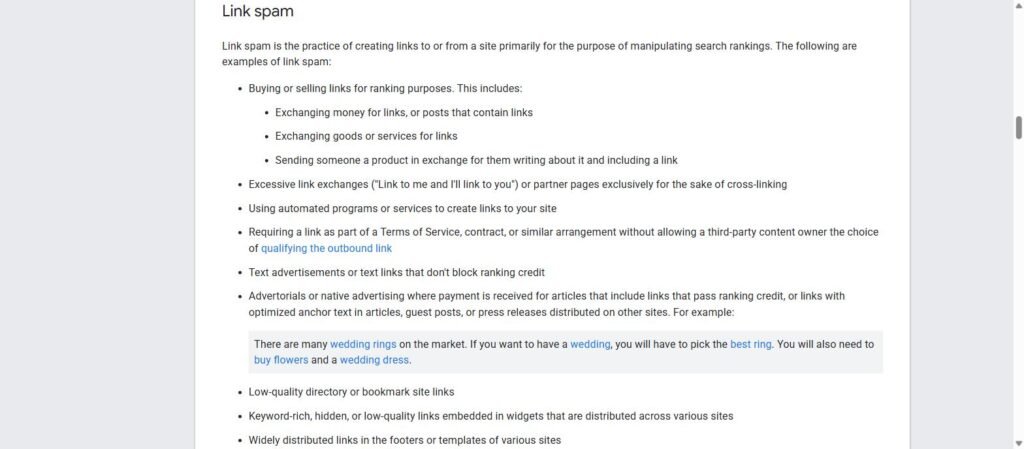
Buying links to pass ranking signals is against Google’s spam policies, and I would be lying if I told you otherwise. In practice, the risk sits almost entirely with obvious, low-quality, high-volume placements. Relevant, editorially placed links on genuine sites with natural anchors are extremely hard to distinguish from organic ones. Understand the risk, keep quality high, and never build your whole profile on paid placements alone.
How much does a link insertion cost in 2026?
Roughly 80 to 400 dollars on real DR 30 to 60 sites in general niches, and 400 to 1,500 dollars or more in finance, health, legal and SaaS. Free placements are possible through genuine outreach, but expect a 3 to 8 percent success rate and a lot of emails.
How many link insertions does a page need?
Look at the referring domains of the pages currently ranking in the top five for your keyword and aim to close that gap with a mix of insertions, guest posts and earned links. For most mid-competition commercial keywords, that is five to fifteen strong links over three to six months, not fifty in a week.
Do link insertions work for brand-new websites?
They do, but be patient and go slow. A new site suddenly gaining ten insertions in a week looks unnatural. Two or three well-placed links a month, alongside your own content and some brand mentions, is a pattern that ages well.
How long does a link insertion take to show results?
Typically three to six weeks if the linking page is already ranking and crawled often, and up to three months on slower sites. If nothing has moved after twelve weeks, re-verify that the link is still live and do-follow before assuming it did not work.
Next step
Pick one commercial page, find five aged articles in your niche that already rank and get traffic, write the sentence you want added to each, and send five personal pitches this week. That single exercise will teach you more about link insertion than any course. If you would rather have it run for you as part of a full campaign, take a look at my SEO services or get in touch, and I will show you what a qualified link insertion pipeline looks like for your niche.