
Every month a client asks me the same budget question: niche edits vs guest post, which one deserves the money this quarter? I have been buying both since 2019, for my own sites and for clients in SaaS, home services and finance, and the honest answer is that they do two different jobs.
One puts your link on a page that already has standing with Google. The other gives you a brand new page on a site you do not own. Price, waiting time and failure rate are all different, so choosing on gut feeling is how people burn a quarter of a budget and end up with nothing that moved.
Below is the niche edits vs guest post comparison I actually walk clients through, with the prices I paid at the time of writing and what I saw in the rankings afterwards.
Whichever one you buy, the placement only counts once Google has crawled it, so I always check if backlinks are indexed before a placement goes in the report.
Niche edits vs guest post: the short answer
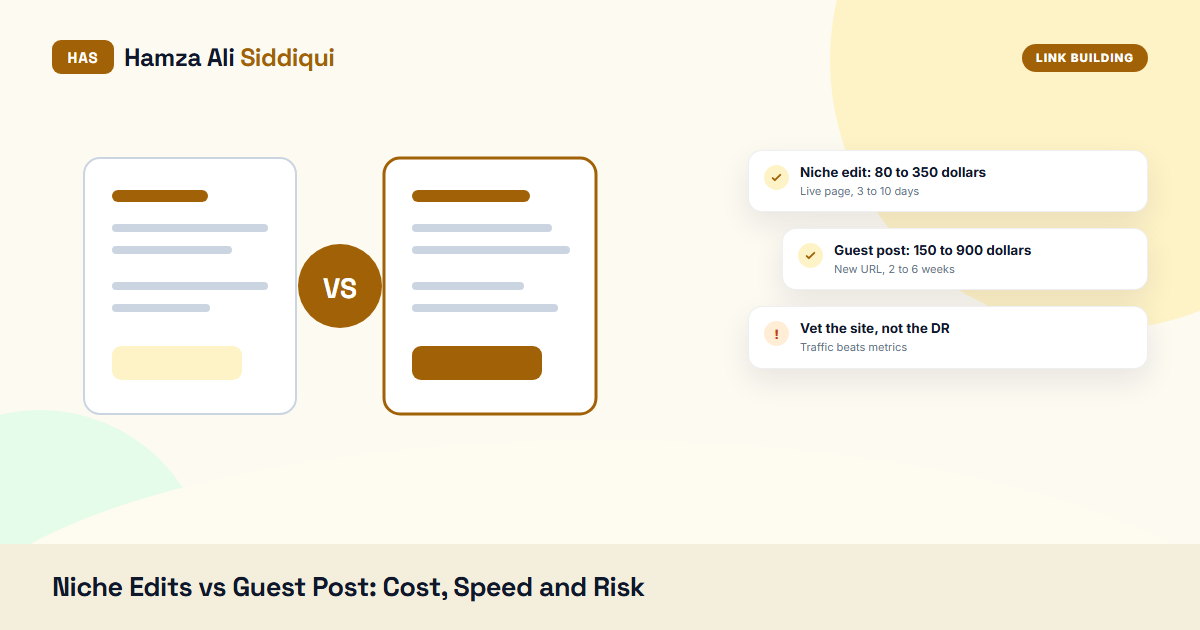
If you want the decision in ten seconds: buy niche edits when a page of yours is already sitting on page two and needs a shove, and buy guest posts when you need topical coverage, brand mentions and link equity you can redistribute later. Here is the side by side I keep in my proposals.
| Niche edit | Guest post | |
|---|---|---|
| Typical price per link | $80 to $350 | $150 to $900 all in |
| Turnaround | 3 to 10 days | 2 to 6 weeks |
| Where the link sits | Inside an article that is already published | Inside a new article written for the placement |
| Control over the copy | Low, you send one sentence and hope | High, you write the whole piece |
| Indexing | Host page is usually indexed already | New URL, can take weeks to get picked up |
| Best used for | Moving a page from 15 to 8 | Relevance, brand, deep pages later |
| Main risk | The seller runs a network of dead blogs | Your post is buried in a category nobody reads |
What a niche edit actually is
A niche edit is a link added into an article that has been live for months or years. The site owner opens the post, drops in a sentence or edits an existing one, and your URL goes in with the anchor you agreed. Sellers also call it a link insertion, a curated link or a contextual link, and I have written about the process in detail in my guide to link insertion.
The appeal is obvious. The host page may already rank, it may already have links of its own, and Google does not need to discover a new URL. In my logs the median time from payment to a link that Google has recrawled is about nine days for a niche edit. For a guest post it is closer to thirty.
The catch is that you are buying into someone else’s writing. If the paragraph around your link reads like it was bolted on, it looks bolted on to a reviewer too. I ask for the exact sentence before the money moves, and I reject anything that opens with a line like “if you want to learn more about”. A link sitting in the middle of a real argument is worth three sitting in a tacked-on final paragraph, which is the same principle behind contextual backlinks.
What a guest post actually is
A guest post is a new article published under your name or your client’s name on somebody else’s site, with one or two links back. You pitch, you write, an editor publishes. Ahrefs still has the clearest breakdown of the outreach side in their guest blogging guide, and my own workflow for pitching sits in my post on guest posting.
What you get here is control. You choose the topic, the angle, the context around the link and the anchor. You can write a piece that ranks on its own and keeps sending referral clicks two years later. I have a guest post from 2021 on a small logistics blog that still sends my client about forty visits a month, and not one of my niche edits has ever done that.
You also pay for that control in time. Writing, revisions, editor silence, a publish date three weeks out. Plan for six weeks and be pleasantly surprised. In a niche edits vs guest post timeline, this waiting period is the single biggest practical difference.
Niche edits vs guest post on price
Prices in this market move around, but here is what I paid across roughly sixty placements in the last twelve months. Treat these as the going rate at the time of writing, not a fixed menu.
- Niche edit, DR 20 to 39 site with real traffic: $80 to $150.
- Niche edit, DR 40 to 59: $150 to $280.
- Niche edit, DR 60 plus: $300 and up, and past $500 I walk away unless the host page itself ranks for something my client wants.
- Guest post, DR 20 to 39: $120 to $250 including the writing.
- Guest post, DR 40 to 59: $250 to $500.
- Guest post, DR 60 plus: $500 to $900, and the good ones want a real author with a real profile.
The pattern is steady. At the same DR, a niche edit costs about 30 percent less than a guest post because nobody has to write two thousand words. If you want to sanity check a quote before you reply to it, I built a free guest post price calculator that prices a placement off DR, traffic, niche and link type, and it flags sites whose traffic does not match their DR. An Ahrefs study that asked 450 site owners for a price found an average of $361.44 per paid link, which tells me the sellers quoting $1,200 for a DR 45 blog are simply testing you.
Which one moves rankings faster
This is where the niche edits vs guest post argument usually gets settled for me, and it depends entirely on where the page already sits.
Last November a fintech client had a comparison page stuck between position 12 and 16 for four months. The content was fine, the internal links were fine, it just had two referring domains. I bought three niche edits on finance blogs with real organic traffic, spread over five weeks, anchors split between the brand name and a partial match. The page hit position 6 in about forty days and settled at 5. Total spend was $540.
Same quarter, a different client launched a tool site with almost nothing pointing at it. I ran niche edits there first because they were cheap, and they did close to nothing. What finally worked was six guest posts over three months, each covering a subtopic around the tool, each linking to a different page. That site went from 30 clicks a month to about 900. Niche edits amplify a page that is already close. Guest posts build the ground the page stands on.
So the speed question has a boring answer. On a page that already sits on page two, a niche edit shows up in the rankings sooner. On a young domain, neither one is fast, and guest posts are the ones that compound.
Which one carries more risk
Both are paid links, and Google’s link spam policy treats paid links that pass ranking signals as a violation whichever shape they take. Anyone telling you niche edits are safe because the page is old is selling something. The real difference is in the footprints each one leaves.
Niche edit sellers tend to work from a fixed list of sites. Buy from three vendors and you will often see the same domains in all three lists. Those sites end up with dozens of inserted links across old posts, no new content for years, and a traffic graph that fell off a cliff. That is the pattern I check for before I spend anything: recent publishing activity, organic traffic that did not collapse, and outbound links that are not all commercial.
On the niche edits vs guest post risk question, guest posts carry a different problem. Sites that accept anyone drift into a write-for-us farm, where the same five agencies publish every week. My filter is simple. If the last ten posts are all by different one-time authors and all link out to money pages, I pass. If the blog also publishes its own editorial and has an audience, I buy.
Anchor text is the other lever people get wrong on both sides. Exact match anchors are tempting on a niche edit because you are only buying one sentence, and that is exactly how a profile tips over. I keep exact match under 5 percent of the profile and check it with my anchor text ratio checker before every campaign.
My 90-day split for a client site
When a client hands me a budget and asks how to divide it between niche edits vs guest post placements, I do not split it evenly. I split it by what the site needs first.
- Weeks 1 to 4, mostly guest posts. Three or four placements on relevant sites, links pointed at the homepage and the two best commercial pages. This sets a base and gives Google topical context.
- Weeks 5 to 8, mixed. Two more guest posts, plus two niche edits aimed at whichever page moved into the top 20 after month one.
- Weeks 9 to 12, mostly niche edits. Four to six inserts on pages that already rank for terms close to the target keyword, anchors varied, each one pointed at a specific URL rather than the homepage.
Roughly 60 percent of the budget goes to guest posts in month one and roughly 70 percent goes to niche edits by month three. If you would rather hand the whole thing over, that is what my link building packages cover, and the same logic sits behind the way I buy backlinks for my own projects.
Five mistakes I see in niche edits vs guest post buying
- Buying on DR alone. A DR 58 site with 200 monthly visitors is a worse buy than a DR 28 site with 9,000. Check the traffic, and check which countries it comes from.
- Accepting the vendor’s page choice. They will offer whichever post is easiest for them. Ask for a page that ranks for something related to your topic, and ask for the traffic number on that exact URL.
- Putting every link on the homepage. Homepage links are easy to sell and rarely move a specific keyword. Point links at the page you want ranked.
- Ordering ten links in one week. A quiet site that suddenly gains ten paid links looks like exactly what it is. Spread them out.
- Never checking if the link survived. I recheck every placement at 30 and 90 days. Around one in fifteen disappears, and most vendors will replace it if you ask inside the guarantee window.
So which one should you buy?
My niche edits vs guest post rule, after six years of buying both, comes down to this: if the page you care about is already in the top 20, niche edits give you the cheaper and faster win. If it is nowhere, or the domain is young, guest posts build something you can point links at later. Most campaigns I run use both, just not in equal amounts at the same time.
And whichever side of niche edits vs guest post you land on, the vetting matters more than the format. A good link on a real site beats a cheap link on a dead one, every single time.
FAQ
Are niche edits safe in 2026?
They carry the same policy risk as any paid link. What makes them safer in practice is the host site: recent publishing, real organic traffic, a sensible ratio of editorial to commercial outbound links, and a sentence that reads like the writer meant it.
In niche edits vs guest post, which is cheaper?
Niche edits, by roughly 30 percent at the same domain rating, because there is no article to write. A DR 40 insert ran me $150 to $280 at the time of writing, while a guest post on the same site was $250 to $500.
How long before a niche edit affects rankings?
In my tracking the host page gets recrawled in about a week to ten days, and any ranking movement shows up over the following three to six weeks. If a page sits at position 12 to 20, that is where you see it first.
Can I get niche edits without paying for them?
Yes, and it is worth trying before you open the wallet. Broken link outreach and unlinked mention outreach both end with an editor inserting your link into an existing page, which is a niche edit by another name.
How many links does one page actually need?
Compare against the pages ranking above you instead of picking a number. Pull their referring domains for that URL, take the median, and plan to get close to it over a quarter rather than a week.
Should a new site start with guest posts or niche edits?
Guest posts. A new domain has no pages close enough to the top 20 for an insert to push, so the money does more work on relevance and coverage first.