
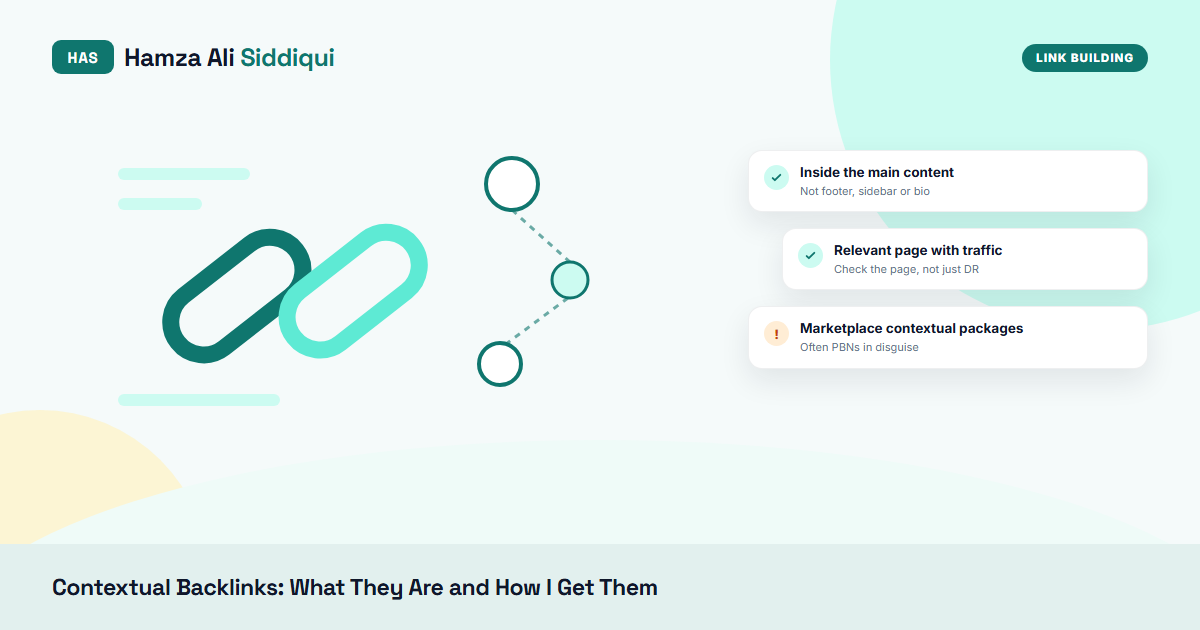
Contextual backlinks are the only kind of link I still pay real money for. A contextual backlink is a link placed inside the body of an article, surrounded by text that talks about the same thing your page covers. Not a footer link, not a sidebar widget, not an author bio. After building links for clients since 2019, I would take one contextual link from a relevant page with traffic over ten directory or profile links, and the ranking data I have seen backs that up.
This guide covers what separates contextual backlinks from everything else, the five ways I get them, what each one costs at the time of writing, and the checks I run before a link goes into a client report.
What contextual backlinks are, in plain terms
Picture a blog post about meal prep for busy parents. Halfway through, the writer says a glass container set held up better than plastic and links to a kitchen store’s container page. That link is contextual. The words around it tell Google what the linked page is about, and a reader has a real reason to click it.
Now picture the same kitchen store listed in the site’s footer under “Our partners.” Same domain, same link, far less value. Google has said for years that it looks at the text around a link, and its documentation on links asks site owners to make anchor text and the words around it descriptive. Placement inside the main content is part of that picture.
Contextual vs non-contextual links: a side by side look
| Link type | Where it sits | Typical value in my experience | Risk level |
|---|---|---|---|
| Contextual link in a relevant article | Main body copy | High | Low if the site is real |
| Author bio link | End of a guest post | Low to medium | Low |
| Resource page link | A curated list | Medium | Low |
| Sidebar or footer link | Every page on the site | Low | Medium to high |
| Directory or profile link | A listing page | Very low | Low, but mostly ignored |
| Comment or forum signature | User content | Near zero | Medium |
Sitewide footer links are the ones that worry me. One of my clients in 2022 had a single web design agency footer link that showed up as 4,100 backlinks in Ahrefs. It did nothing for rankings, and it made the anchor profile look strange. We had it moved into a case study page instead, as a contextual link, and the client’s homepage moved from position 14 to 9 over the next two months. I cannot prove that one change caused it, but it was the only link work we did in that window.
Why contextual backlinks carry more weight
There are three reasons I keep coming back to.
- Relevance signals. The paragraph around the link gives Google extra context beyond the anchor itself, so the link supports the topic you want to rank for.
- Real clicks. People click links that answer a question in the sentence they are reading. Referral traffic is a good sign that a link is editorial, and it is the only benefit you can measure directly.
- They look earned. A link in the middle of useful content is what a natural link looks like. That makes contextual backlinks harder to tell apart from links you never asked for.
None of this makes a contextual link safe by default. A contextual link on a site that publishes 40 unrelated “sponsored” posts a week is still a paid link on a link farm.
5 ways I get contextual backlinks for clients
1. Link insertions into articles that already rank
This is my first choice for most campaigns. I find an existing article that ranks for a related term, write the exact sentence I want added, and ask the owner to include it. The page is already indexed and trusted, so the link starts counting quickly. I explain the full process in my guide to link insertion. Genuine sites with traffic charge roughly $80 to $400 per insertion right now.
2. Guest posts where the link sits in the body
A guest post only gives you a contextual backlink if the link sits in the article itself, not just in the bio. I always place the client link in the second or third section, next to a claim it supports. Editors remove fewer links placed that way because the link helps the reader. My notes on guest posting cover how I find sites worth writing for.
3. Unlinked brand mentions
If someone already wrote about your brand without linking, the context is already there. You only need to ask for the link. My conversion rate on these requests sits around 20 to 30 percent, and it costs nothing but time. I wrote a separate walkthrough on turning unlinked brand mentions into links.
4. Journalist requests and expert quotes
When a journalist quotes you in an article, the link usually sits right next to your quote. These are some of the strongest contextual backlinks you can earn because the sites are big and the placement is editorial. The downside is volume. I usually get two to five a month for a client who answers requests every day.
5. Data and original research other writers cite
A small survey, a pricing study or a free tool gives writers a reason to link inside their own content. It is slow to start, but once a resource is cited a few times, these links keep arriving without outreach. That is the reason I build free tools like my anchor text ratio checker.
What contextual backlinks cost in 2026
Prices vary a lot by niche. Finance, health, legal and SaaS sit well above the ranges below. These numbers come from my own invoices and quotes over the last 12 months.
| Method | Typical cost per link | Time to get one | My take |
|---|---|---|---|
| Link insertion (DR 30 to 60) | $80 to $400 | 1 to 3 weeks | Best value for most sites |
| Guest post (DR 30 to 60) | $120 to $500 plus writing | 2 to 6 weeks | Good when you want topical depth |
| Unlinked mention reclaim | Free, about 1 hour of work each | 1 to 4 weeks | Do this first if you have mentions |
| Journalist quotes | Free, 20 to 40 minutes per pitch | Unpredictable | High value, low volume |
| Original data or tools | $500 to $3,000 to build | 2 to 6 months to pay off | Slow, but compounds |
If you want a quick sanity check on a guest post quote, my guest post price calculator estimates a fair range from DR, traffic and niche. For wider benchmarks, Ahrefs’ survey of link builders is a useful reference on what the industry charges.
My checklist before I accept contextual backlinks
Every link goes through these checks before it counts as delivered. If a placement fails two of them, I ask for a replacement.
- The article is on the same topic as the page I am linking to, or a close neighbour.
- The link sits in the main content, above the last third of the article.
- The page is indexed. I search the exact URL in Google or use URL inspection.
- The site shows organic traffic that is steady or growing, not a spike and a crash.
- The site does not publish obvious paid posts on casinos, loans or CBD next to normal content.
- The anchor reads naturally in the sentence and fits my anchor plan for that page.
- The article has fewer than five other outbound commercial links.
- The link is not tagged in a way that contradicts what we agreed.
On that last point: Google asks for paid links to carry rel=”sponsored” or nofollow. Many publishers do not follow that, and I am not going to pretend otherwise. Know the rule, and understand that the risk of an untagged paid link sits with you.
Mistakes I see with contextual backlinks
- Buying “contextual” packages from marketplaces. Many are private blog networks with a thin article wrapped around the link. The link is technically contextual and practically worthless.
- Using the money keyword as anchor every time. Contextual placement does not protect you from a skewed profile. I covered this in detail in my post on anchor text over optimization.
- Ignoring the page and only checking the domain. A DR 70 site can have an orphan page with zero traffic and no internal links.
- Forcing the link into an unrelated article. A link to accounting software in a travel post helps nobody, and editors often remove it later.
- Not rechecking. I lose around 5 percent of placed links per year. Check at 30 and 90 days.
One more mistake deserves its own mention: buying “booster” links to push up the pages that hold your contextual links. I explain why that backfires in my post on tiered link building, along with what I do instead.
How many contextual backlinks do you need?
There is no fixed number. I start by counting the referring domains of the pages ranking in positions 3 to 5 for the target keyword, since the top two often have brand advantages you cannot copy. If those pages have 15 to 25 relevant referring domains, I plan for about the same over six months, with most of them contextual. For a new site I keep the pace to four to eight new links a month so growth looks steady.
If you would rather hand this off, I build contextual backlinks for clients through my link building services, with every placement checked against the list above.
To see which of your existing links are contextual, start with this guide on how to check backlinks and open the linking pages one by one.
FAQ
Are contextual backlinks better than guest post bio links?
Yes, in my experience. A link inside the article body passes more relevance and gets more clicks than a link in an author bio at the end of the post.
Are contextual backlinks safe?
They are only as safe as the site they sit on. A contextual link on a real, relevant site with traffic is low risk. The same link on a network site built to sell links is not.
Do contextual backlinks need to be dofollow?
Dofollow links pass the most ranking value, but nofollow contextual links from strong sites still bring traffic and brand searches. A natural profile has both.
How long do contextual backlinks take to work?
I usually see movement four to ten weeks after a link goes live, once Google recrawls the linking page. Links inserted into already ranking articles tend to show up faster.
Can I get contextual backlinks for free?
Yes. Unlinked brand mentions, journalist requests and original research all earn contextual links without paying publishers. They take more time than paid placements.