
Every SaaS founder I have worked with eventually asks the same question in the same tired way: “We hired an agency, they sent a strategy deck, and six months later we have a DR increase and no idea if it moved a single signup.” I have built links for SaaS clients since 2019, and the deck is almost always the same. The actual work underneath it is simpler than the pitch, and most of it has nothing to do with the generic “guest post outreach” that gets sold to every industry.
This is the version of link building for SaaS that I actually run for clients: the link types that move rankings for software products specifically, the ones that waste budget, and a realistic monthly plan depending on whether you are bootstrapped or funded.
Why link building for SaaS is not the same as ecommerce or local SEO
An ecommerce site earns links to product pages and category pages. A local business earns links from directories and local press. A SaaS product has neither of those naturally. What it does have is a comparison page (“X vs Y”), an alternatives page (“Y alternatives”), an integrations directory, and a docs site — and those four things are where the majority of SaaS backlinks actually originate, not from a founder’s blog post going viral.
That distinction matters because most link building playbooks are written for content sites and ported over to SaaS with no changes. They miss the link sources that are unique to software products and available to a $0 marketing budget startup on day one.
The link types that actually move SaaS rankings, in order of ROI
1. Review platform profiles (G2, Capterra, GetApp, Product Hunt)
Founders rarely count these as “link building” because there is no outreach email involved, but a completed G2 or Capterra profile is a high-authority, topically relevant backlink that took twenty minutes to set up. Capterra and G2 both pass real authority and both rank for “[your category] software” comparison queries themselves, which means your profile link also puts you in front of buyers actively comparing tools. This is the highest ROI-per-hour link source for a new SaaS product and almost nobody treats it as a priority.
2. Integration partner pages
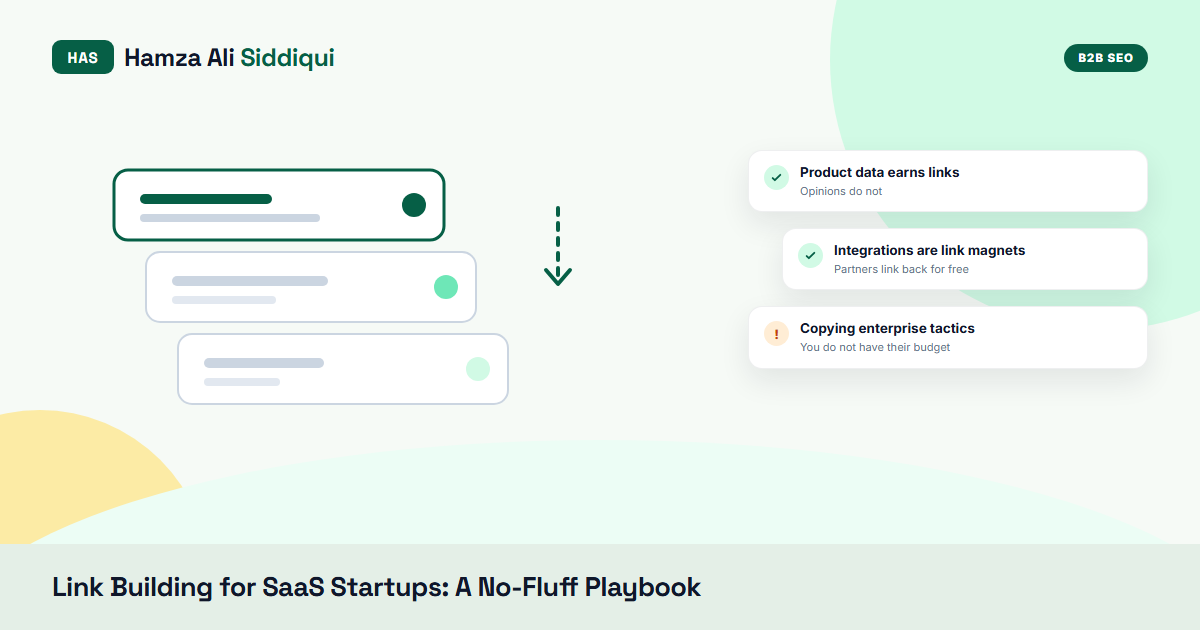
If your product integrates with Slack, Stripe, HubSpot, or a hub like the Zapier app directory, ask to be listed. Most of these directories link back to the partner’s site, and the request is usually a form fill, not a pitch. A 15-integration SaaS product can realistically pick up 10 to 15 relevant, high-authority links this way with zero content production. I run this as the first task on every new SaaS engagement before a single guest post goes out.
3. Getting added to existing “best tools” listicles
Every SaaS category already has ten to thirty “best [category] tools” listicles ranking on Google. These pages update periodically, and their authors are generally open to adding a tool that is genuinely good and easy to describe in two sentences. This is different from guest posting: you are not writing content, you are pitching an existing, already-ranking page to include one more entry. The hit rate is lower than integrations but the pages you land on are usually high-traffic and already ranking for buyer-intent terms.
4. Guest posts on niche SaaS and industry blogs
Standard guest posting still works for SaaS, it just needs a narrower target list than ecommerce link building: SaaS-focused publications, the blogs of complementary (non-competing) tools in your buyer’s stack, and niche industry sites your specific customer reads. My full process for finding and pitching these sites is in my guest posting guide — the short version for SaaS specifically is to prioritize sites your actual buyer persona reads daily over generic “write for us” marketing blogs, which tend to be link farms by now.
5. A proprietary data study from your own product usage
This is the one funded SaaS teams underuse and bootstrapped teams cannot always afford, but it is the highest-leverage link source on this list. If your product generates any aggregate, anonymized usage data (average time-to-close, typical churn triggers, adoption benchmarks), packaging that into one report and pitching it to journalists and niche newsletters earns links that no outreach template can buy: press coverage, cited data points in other people’s articles, and links from domains you could never place a guest post on. One good data study, pitched properly, can outperform six months of guest post outreach.
6. Unlinked brand mentions
Any SaaS product that has been covered in press, mentioned in a roundup, or discussed on a podcast show-notes page almost always has unlinked mentions sitting on real, high-authority domains. These are the easiest links to convert because the writer already decided you were worth mentioning; you are just asking them to add a link they forgot. I cover the exact process in my unlinked brand mentions guide.
What does not work for SaaS specifically
- “SaaS backlink packages” sold in bulk. If a vendor is selling the same 50-link package to every SaaS client regardless of category, those links are on a network built for exactly that, and Google has gotten efficient at devaluing them.
- Directory submissions beyond the ones that matter. G2 and Capterra pass value because they are topically relevant and heavily trafficked. Generic “startup directory” submissions with no traffic and no topical relevance mostly do nothing.
- Guest posts on sites with no real audience for your buyer. A DR 40 site that publishes about everything from crypto to parenting is not a SaaS link, it is a link-selling site that happens to have a SaaS category.
- Comment and forum link drops. Still sold as a tactic in 2026, still worth close to nothing, and it associates your domain with a spam footprint if done at any volume.
A realistic monthly link building plan by stage
| Stage | Monthly budget | What to run |
|---|---|---|
| Pre-seed / bootstrapped | $0 to $300 | Review platform profiles, integration directories, listicle outreach — all founder-time, near-zero cash cost |
| Seed / early traction | $800 to $2,000 | Add 4 to 6 guest posts or niche edits per month plus unlinked mention recovery |
| Series A and beyond | $3,000+ | Add one proprietary data study per quarter, plus ongoing guest posting and a dedicated PR push around launches |
If you are buying placements at any of these stages, my guide to buying backlinks safely covers what a real placement should cost and how to spot a network before you pay for it. And if you would rather have this run for you end to end, my link building services page explains exactly what that looks like.
How to measure whether SaaS link building is actually working
Domain Rating going up is not the goal, it is a side effect. For SaaS specifically, track these instead:
- Referral signups from the specific pages you got linked from, not just referral traffic
- Ranking movement on your comparison and alternatives pages, which is where SaaS buyer intent concentrates
- Whether your G2/Capterra category ranking is climbing, since that page itself is often a bigger acquisition channel than your own site
A backlink report that only shows DR movement and total link count is a vanity report. Ask whoever is running your link building — in-house or agency — to tie link placements to the pages and keywords they were meant to support, and check those rankings monthly.
Frequently asked questions about link building for SaaS
How many backlinks does a SaaS startup need to rank?
There is no fixed number. What matters more than count is relevance and placement: 15 well-placed links on integration pages, review platforms, and topically relevant guest posts will outrank 100 generic directory links every time.
Should a SaaS startup do link building before or after product-market fit?
The free, founder-time sources — review platforms, integration directories, unlinked mentions — are worth doing early since they cost nothing but time. Paid guest posting and data studies are worth delaying until you have a stable ICP, so the content and outreach target the right audience.
Do G2 and Capterra profiles really count as backlinks?
Yes. They are standard dofollow or nofollow links depending on the plan, but even nofollow links from high-authority, topically relevant domains contribute to a healthy backlink profile and, more importantly, drive real buyer traffic.
Is it worth hiring an agency for SaaS link building?
It depends on whether they run SaaS-specific tactics or the same generic playbook they use for every client. Ask any agency directly whether integration directories and review platforms are part of their process before signing — if the answer is no, they are running an ecommerce playbook on a SaaS budget.
Start with the free sources this week: your integrations directory, your G2 and Capterra profiles, and a quick unlinked-mentions search on your product name. Those three alone usually produce more usable links in a weekend than most SaaS teams get from a full quarter of generic outreach.