
Ecommerce link building is the job I quote highest and promise least on. Not because it is shady, but because nobody wakes up wanting to link to a product page. A blogger will happily cite a study. They will almost never cite “Men’s Waterproof Hiking Boot, Size 9-12, $129.” So the work is less about getting links and more about getting links somewhere useful, then moving that value to the pages that actually make money.
I have run link campaigns for online stores since 2019, mostly Shopify and WooCommerce shops doing between $20k and $400k a month. Most guides on this topic give you a list of 10 or 15 tactics and stop. Fine. What they skip is the boring part that decides whether the links pay off: which pages to point them at, how many you need, what it costs, and how the value reaches your category pages. That is what this post is about.
A real store, before and after (the numbers first)
Let me start with one ecommerce link building campaign, because it shapes everything below. A client sells handmade leather goods: wallets, belts, a few bags. When they came to me they had 31 referring domains, almost all of them to the homepage, from supplier directories and a couple of old press mentions.
Their goal was simple. Rank the “leather bifold wallet” category page, which was stuck at position 18 with about 2,400 US searches a month behind the main term.
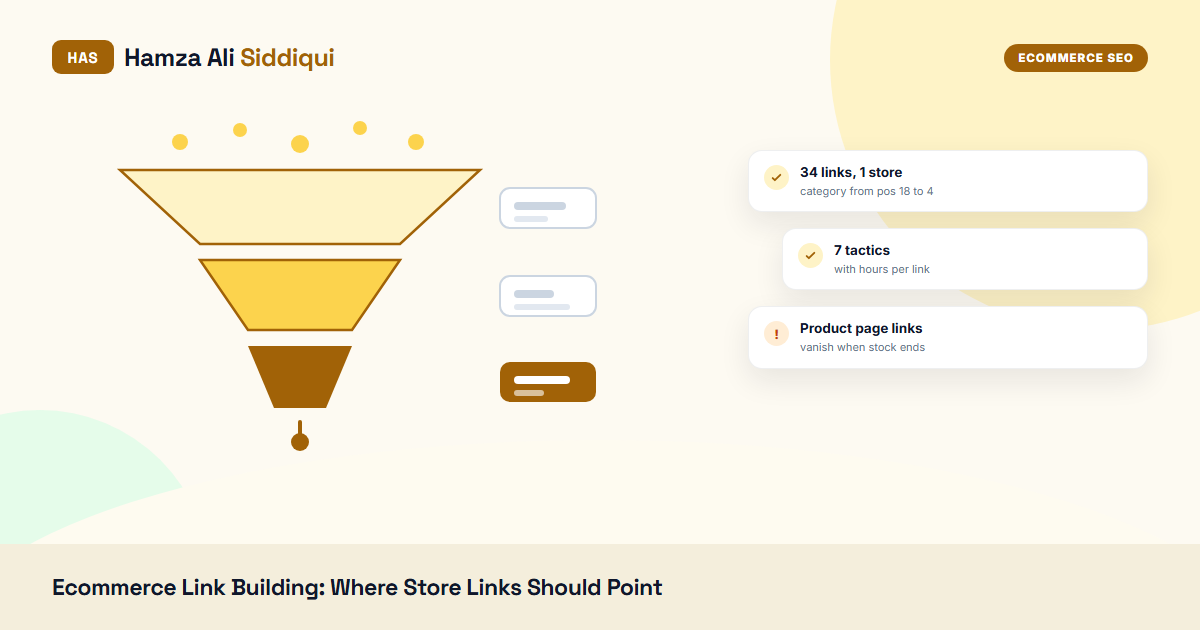
Over five months we built 34 new referring domains. Here is where they went:
- 14 links to a care guide (“How to clean and condition a leather wallet”)
- 9 links to the homepage (gift guides, a local press piece, two maker roundups)
- 7 links straight to the wallet category page (gift guides and two product reviews)
- 4 links to individual product pages (reviews from bloggers we sent samples to)
The care guide linked to the wallet category in its second paragraph and again near the end. The category page moved from 18 to 6 by month five and to 4 by month seven. Organic revenue from that one category went from roughly $1,900 a month to $7,300. Total spend was about $9,800, including the samples we posted out.
Notice only 7 of the 34 links hit the money page directly. That ratio is normal in ecommerce link building, and it is the first thing I explain to new clients.
Where ecommerce link building should point
Every store has four kinds of pages that can take links. They are not equal. This is how I rank them at the time of writing:
| Page type | How easy to get links | SEO value per link | What I use it for |
|---|---|---|---|
| Homepage | Easy | Medium (spreads thin) | Brand mentions, press, partner and supplier links |
| Category pages | Hard | Highest | Gift guides, “best X” roundups, niche edits |
| Product pages | Medium (reviews) | Medium, risky if the product gets discontinued | Blogger reviews, influencer posts |
| Blog guides and tools | Easiest | High if they link to categories | Outreach, resource pages, broken link building |
Category pages are where most store revenue from search comes from, because they target the plural, commercial keywords (“leather wallets for men”) that buyers actually type. Google’s own ecommerce guidance spends a lot of time on site structure and how category and product pages connect, and that is no accident. Links you earn elsewhere only help a category page if your internal links carry them there.
So the ecommerce link building plan is usually: earn links to content that people want to cite, then pass that value to categories through tight internal links. I wrote more about that flow in my internal linking strategy guide.
7 ecommerce link building tactics I still use
These are ordered by how often they end up in my client plans, not by how clever they sound. I have put rough hours per live link next to each one, from my own tracking sheets.
1. Gift guides and “best X” roundups (3 to 5 hours per link)
This is the one ecommerce link building tactic that lands links on category and product pages naturally. Bloggers and small publications update gift guides every October and November. Search for “gift ideas for [audience] 2026” and “best [product] under $100”, list every page from the last two years, and pitch in late August or September. Offer a sample or a discount code for their readers. Pitch in December and you are too late.
2. Supplier, manufacturer and stockist pages (1 to 2 hours)
If you stock a brand, that brand often has a “where to buy” page. If you make your own goods, your material suppliers sometimes list customers. Ask. It is the fastest win in ecommerce link building, and most stores never send the email. One client got 6 links in a week this way, all from relevant sites with real traffic.
3. Care, sizing and how-to guides (4 to 8 hours)
The leather care guide from the example above. Every product has a “how do I use, clean, fit, store or choose this” question. Write the best answer on the web, with your own photos and specifics, then pitch it to bloggers who wrote older or thinner versions. The guide earns links and sends them on to your categories.
4. Unlinked brand mentions (1 hour)
Stores get mentioned more than they think: in Reddit roundups, local news, forum threads copied into blogs. Find mentions without a link and ask for one. My full process is in the unlinked brand mentions guide. Hit rate for stores is around 20 to 30 percent in my sheets, better than any cold pitch.
5. Product reviews from small bloggers (3 to 6 hours plus the sample)
Send a product, ask for an honest review, never ask for a dofollow link or set anchor text in exchange for the free item. Google’s link spam policy treats links given in exchange for products as paid links, so reviewers should mark them sponsored or nofollow. I still do these because the traffic and the review content help sales, and plenty of reviewers link to you later in other posts on their own.
6. Niche edits on existing roundups (cash cost)
Some “best X” articles already rank and get traffic. Asking the owner to add your product as an option is a link insertion, and on decent sites it costs money. I use it carefully and only on pages that already have readers. If you go this route, check prices with my guest post price calculator first so you do not overpay for a site with fake traffic.
7. Local press and maker stories (5 to 10 hours, lumpy)
Small brands have stories: a founder who started in a garage, a factory in a small town, a product made from recycled material. Local papers and niche trade blogs like these. One pitch can fail ten times then land three links in one week. I never plan a budget around this, I treat it as a bonus.
Ahrefs has a decent breakdown of a few more ideas in their e-commerce link building post, if you want extra options. The seven above are the ecommerce link building tactics I can defend in a client budget.
What ecommerce link building costs per month
People ask me for a single ecommerce link building price. There isn’t one, but there are ranges. These are typical monthly budgets I see at the time of writing for stores in the US and UK:
| Store size | Monthly budget | New referring domains | Mix |
|---|---|---|---|
| New store, under $10k/mo revenue | $500 to $1,000 | 3 to 5 | Suppliers, mentions, 1 guide |
| Growing, $10k to $100k/mo | $1,500 to $3,500 | 6 to 12 | Guides, gift guides, a few niche edits |
| Established, $100k+/mo | $4,000 to $10,000 | 12 to 25 | Digital PR, data pieces, reviews |
The hour math is simple. If a guide link takes 6 hours and your link builder costs $35 an hour, that is $210 per link before any fees. Paid placements on mid-authority blogs run $150 to $400 each right now. My full breakdown by link type is in the link building cost guide.
A quick sanity check I give clients: if one category page brings $5,000 a month at position 3, and it sits at position 12 today, spending $6,000 over six months to move it is a good trade. If the page brings $300, it isn’t.
My 90-day ecommerce link building checklist
This is the ecommerce link building order I run for a new store client. Tick each line before moving to the next block.
Days 1 to 14: setup
- Pick 3 category pages with real revenue and positions between 8 and 25
- Check their current backlinks and anchor mix (my anchor text ratio checker does this in a minute)
- Add internal links from the blog and homepage to those 3 categories
- Email every supplier and brand you stock about a “where to buy” listing
Days 15 to 45: linkable content
- Write one care, sizing or buying guide per target category
- Link each guide to its category in the first 150 words
- Run an unlinked mention search and send the first batch of requests
Days 46 to 90: outreach
- Pitch the guides to 40 to 60 bloggers who covered the same topic
- Pitch gift guides (if it is August to October)
- Place 2 to 4 niche edits on pages that already rank, only if budget allows
- Log every live link with target page, anchor and date
By day 90 a typical store of mine has 8 to 15 new referring domains. Rankings usually start moving in month three or four. If you want to know why it takes that long, I covered the timing in how long backlinks take to work.
Ecommerce link building mistakes I keep seeing
- Building links to product pages that will disappear. Seasonal or limited items get deleted, the URL 404s and the links are wasted. Point links at categories or evergreen products, and 301 retired product URLs to the closest category.
- Exact match anchors on category pages. Ten links that all say “leather wallets for men” look bought. Keep exact match under about 10 percent; the rest should be brand, URL and natural phrases.
- Buying cheap link packages. “50 DR 50 links for $99” is almost always a network of sites that sell to everyone. I have cleaned up three stores this year that bought these.
- Orphan guides. A guide that earns 20 links but never links to a category is a traffic page, not a money page.
- Ignoring faceted URLs. If links land on filter URLs with parameters, make sure the canonical points to the main category, or that value leaks.
- Stopping after two months. Most stores quit right before the work starts to show.
Ecommerce link building: in-house or hire someone?
My honest answer: do the supplier links, unlinked mentions and internal linking yourself. They need knowledge of your business more than outreach skill, and they cost almost nothing. Hire out the guide outreach and gift guide pitching if you do not have 10 to 15 spare hours a week.
If you hire, ask any agency three questions: which pages will the links point to, can I see the live URL list every month, and what happens to links that drop? If they cannot answer the first one, they are selling volume, not results. You can see how I structure store campaigns on my link building services page.
Ecommerce link building is slow, and that is the whole edge. Most of your competitors will try it for six weeks, buy a cheap package, and give up. Point your links at the right pages, keep the anchors boring, and keep going.
FAQ
What is ecommerce link building?
It is the work of getting other websites to link to an online store, so its category and product pages rank higher in Google. For stores, most links land on guides or the homepage first, and internal links pass that value on to the pages that sell.
Should backlinks go to product pages or category pages?
Category pages, in most cases. They target bigger commercial keywords and they do not disappear when stock runs out. I only point links at product pages for evergreen bestsellers or when a reviewer links there naturally.
How many backlinks does an ecommerce site need?
It depends on the competition, so check how many referring domains the top 5 category pages for your keyword have. In my campaigns, 8 to 15 new relevant referring domains over 90 days is usually enough to move a category from page two to page one in a mid-competition niche.
Is it safe to send free products for backlinks?
Sending products for an honest review is fine. Asking for a dofollow link in exchange is not; Google counts that as a paid link. Let reviewers decide, and expect them to add a sponsored or nofollow tag.
How long does ecommerce link building take to show results?
Usually three to six months of ecommerce link building for a category page to move noticeably. Links need to be crawled and indexed first, and new stores take longer than stores with some existing authority.