
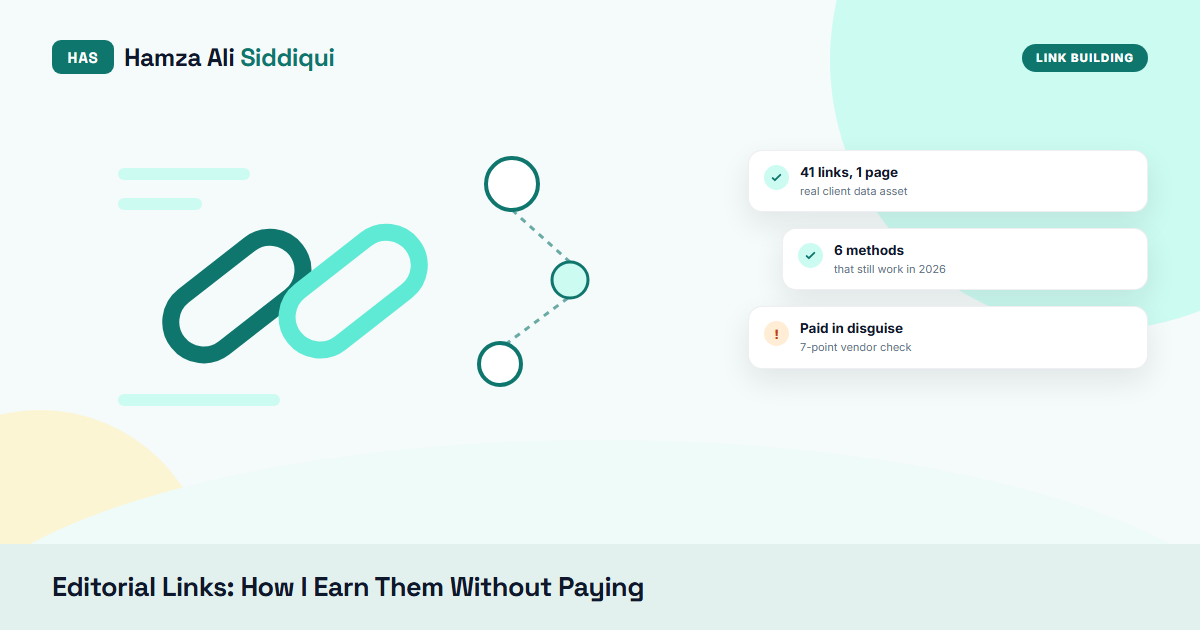
Editorial links are the only backlinks I have never had to invoice anyone for. A writer finds your page, decides it helps their reader, and links to it on their own. No payment, no swap, no “can you add my link here” email. Last year one of my SaaS clients got 41 of them from a single pricing study, and those 41 links moved more keywords than the 60 guest posts we had placed in the six months before.
Most pages ranking for this term are glossary entries. They tell you what an editorial link is in two sentences and stop there. That is fine if you only need a definition. If you want to actually get some, you need to know what counts, what does not, how long it takes and what it costs in hours. That is what this post covers, from what I have seen building links since 2019.
What editorial links are (and the simple test I use)
An editorial link is a link a publisher chose to add because the page deserved it. The site owner or writer controls the decision. Ahrefs describes it as a link that is not traded for, asked for, or paid for, which is the clean textbook version.
In practice I use a looser test with clients. I ask one question: could the publisher have said no, and would they have lost nothing by saying no? If yes, and they still linked, it is editorial. A journalist who quotes your data after you emailed them still made the call. A blogger who links because you paid $150 did not really make a call at all.
That matters because Google treats the two very differently. Its spam policies on link schemes name buying or selling links for ranking, excessive exchanges and large-scale article campaigns with keyword-rich anchors. Editorial links sit on the other side of that line. They are the kind of vote the whole PageRank idea was built on.
Editorial links vs the links most people buy
Here is how I explain the difference on sales calls. The prices are what I see at the time of writing for mid-authority sites (DR 40 to 60).
| Link type | Who decides | Typical cost | Risk | Anchor control |
|---|---|---|---|---|
| Editorial link | Publisher | $0 cash, 3 to 15 hours of work per link | Very low | None |
| Guest post | Shared | $80 to $400 | Low to medium | Partial |
| Niche edit / link insertion | Mostly you | $60 to $350 | Medium | Full |
| PBN or link farm | You | $20 to $80 | High | Full |
Notice the last column. The price you pay for editorial links is control. You do not choose the anchor, the page or sometimes even whether the link is dofollow. Most of my clients hate that for about two weeks and then love it, because the anchors end up looking exactly like a natural profile should. If you want to see how skewed your current anchors are, paste them into my free anchor text ratio checker before you start.
A worked example: 41 editorial links from one page
The client was a B2B invoicing tool with a DR of 22. Their blog was fine, but nobody had a reason to cite it. So we built one asset: a page comparing the published pricing of 112 invoicing and billing tools, updated every quarter, with a median price per seat by company size.
The numbers, roughly as they landed:
- Research and page build: 34 hours (me plus one analyst), about $1,700 of time.
- Outreach: 212 emails to writers who had covered SaaS pricing in the last 12 months, 19 hours.
- Replies: 38, of which 14 turned into links within 30 days.
- Month 2 to 6: another 27 links arrived with zero outreach, mostly from writers who found the page on Google while researching their own articles.
- Total: 41 referring domains, 33 dofollow, median DR 48, cost per link about $62 in time.
That second wave is the part people underrate. Once a data page ranks for phrases like “average cost of X”, journalists find it by themselves and keep linking. The page still picks up one or two links a month, almost two years later.
How to get editorial links: 6 methods I still use
I have tried most tactics you will read about. These are the six that still produce editorial links for my clients in 2026, roughly in order of return per hour.
1. Publish numbers other writers need
Writers need a source for every stat they quote. If your page is the easiest place to find a specific number, you get linked. Pricing surveys, salary data, benchmark tests and “we analysed 1,000 X” posts all work. Small and specific beats big and vague. “Average response time of 50 SaaS support teams” earns more links than “The State of Customer Support”.
2. Answer journalist requests
Sites like Qwoted, Featured and the newer HARO replacements send daily requests from writers who need an expert quote. The hit rate is low, maybe 1 in 12 pitches for most of my clients, but the links come from real publications. I wrote up my process in HARO link building, and it still applies to the replacement platforms.
3. Turn brand mentions into links
If a site already wrote about you without linking, it already made the editorial decision. You are only asking for a missing citation. I get around a 25 to 30 pct success rate on these, higher than any cold pitch. The full routine is in my post on unlinked brand mentions.
4. Build a free tool
Calculators and checkers get linked from “best free tools” lists and from tutorials. I built two for this site, including a guest post price calculator, partly to test this. A tool does not need to be fancy. It needs to save someone ten minutes.
5. Write the definitive page on a narrow term
When you rank in the top 3 for a term writers look up, you collect citations passively. This is slow. It usually takes 4 to 8 months before the links start, and you need a few links first to get there. Think of it as a compounding account, not a campaign.
6. Be the founder with an opinion
Podcasts, roundups and newsletter features love founders who will say something specific. One client said on a podcast that “most SaaS onboarding emails should be deleted”, and that single line got quoted and linked by 9 blogs. Bland opinions get zero links. Sharp ones with a reason behind them travel.
A realistic 90-day plan for editorial links
This is the timeline I give a new client with a small site and about 10 hours a week to spend. It is not magic. It is just the order that has worked most often for me.
| Weeks | Focus | Hours | Expected links |
|---|---|---|---|
| 1 to 2 | Find and claim unlinked mentions, fix broken links pointing to you | 8 | 2 to 5 |
| 3 to 6 | Build one data asset or free tool | 25 to 35 | 0 |
| 7 to 9 | Outreach to writers who covered the topic in the last year | 15 to 20 | 5 to 15 |
| Every week | 2 to 3 journalist request pitches | 2 | 1 to 3 over the 90 days |
| 10 to 13 | Refresh the asset, pitch the update, start asset number two | 15 | 3 to 8 |
So after 90 days a small site can expect somewhere between 10 and 30 editorial links. That sounds low next to a package of 50 guest posts. But in my experience one good editorial link from a real publication does more than five average guest posts, and it does not carry the same risk if Google tightens things again.
How to tell if a link is really editorial
Plenty of vendors now sell “editorial links”. Some are honest about outreach. Some are selling paid placements with a nicer name. Before a client signs off on a vendor, I run this checklist on 5 sample links:
- Does the site have a “write for us” page or a price list? If yes, it probably sells links.
- Do other posts on the site link out to random casinos, loans or CBD shops? Bad sign.
- Is the link inside a paragraph that would still make sense without it? Editorial links usually are.
- Is the anchor a brand name, a URL or a natural phrase? Exact-match money anchors on every link point to a sold placement.
- Did the article exist before the link, or was it written the week the link appeared? Both can be fine, but a fresh post with 3 outbound commercial links is not editorial.
- Does the site get real organic traffic in Ahrefs or Semrush, with a steady trend rather than a spike and crash?
- Is the link tagged with rel=”sponsored”? Google asks publishers to mark paid links that way, so a sponsored tag tells you exactly what it is.
If 3 or more of the 5 sample links fail, I do not care what the vendor calls them. They are paid links, and they should be priced and treated that way. I covered the honest side of buying in my post on paid backlinks.
Mistakes that kill editorial links before they happen
- Pitching a page nobody would cite. A product page or a generic “10 tips” blog post will not earn links, however good your email is. Fix the asset first.
- Asking for a specific anchor. The moment you say “please use the anchor best invoicing software”, you have turned an editorial link into a negotiated one. Let the writer choose.
- Mass templates. I still see 1,000-email blasts with “Hi {name}”. Reply rates on those sit under 1 pct. My best campaigns use 150 to 250 hand-checked contacts.
- Giving up at month two. The passive links from ranking data pages usually start around month three or four. Most people quit right before that.
- Hiding the data. Gating a study behind an email form cuts links hard. Writers will not link to a page their readers cannot see.
Where editorial links fit in a full link plan
I do not think editorial links should be the only thing you build. They are slow and you cannot aim them at a specific money page. What I usually recommend is a mix: editorial links for the domain’s authority and trust, plus a smaller number of contextual backlinks from guest posts to push particular pages. Something like 60 pct earned, 40 pct placed works well for most SaaS sites I have audited.
If you do not have the hours for this yourself, it is the kind of work I do for clients through my link building services. Either way, start with one asset worth citing. Everything else in this post depends on that.
Editorial links FAQ
Are editorial links always dofollow?
No. Some big publications add nofollow to every outbound link by policy. In my client data, about 20 pct of editorial links are nofollow. They still send referral traffic and help the profile look natural, so I count them.
Can you buy editorial links?
Not in the strict sense. Once money changes hands for the link itself, it is a paid link, whatever the vendor calls it. You can pay someone for the outreach work, the research or the content that earns editorial links, which is a different thing.
How long does it take to get editorial links?
For a new data asset, the first outreach-driven links usually land within 2 to 4 weeks. The passive links that come from ranking on Google usually start around month three and can keep coming for years.
What is an example of an editorial link?
A journalist writing about SaaS pricing trends finds your pricing study, quotes one of your numbers and links to the page as the source. You did not pay for it or ask for that exact article. That is an editorial link.
How many editorial links does a small site need?
It depends on the niche, but for low-competition keywords I often see pages rank in the top 10 with 5 to 15 good referring domains. Ten solid editorial links to a young domain usually change how Google treats the whole site.