
Every few weeks a client asks me why their competitor has a backlink from Forbes or Business Insider and they do not. The honest answer is almost never “better content.” It is that the competitor spent 20 minutes a day answering journalist queries on a source-matching platform, and eventually one of those replies got quoted with a link back to their site. I started doing this seriously in 2026 after HARO shut down and its traffic scattered across Connectively, Qwoted, and Featured, and it is now one of the few link building channels I run personally instead of delegating.
This is what actually works with HARO link building in its current, post-rebrand form: which platforms are worth your time, how to write a pitch that gets picked over 40 other replies, and the realistic hit rate you should expect before you give up on it.
HARO technically does not exist anymore
Help A Reporter Out (HARO) was acquired by Cision and shut down in mid-2025, replaced internally by a paid tool called Connectively. At the same time, a wave of alternatives that had already been competing with HARO for years absorbed a lot of the displaced users: Qwoted, Featured (formerly Terkel), and a handful of smaller Slack-based journalist communities. When people still search “HARO link building” in 2026, this is what they actually mean: pitching journalists and content writers through one of these source-matching platforms, not the original free HARO product.
The mechanics did not change much. A journalist or content writer posts a request describing what they need a quote or data point on. Sources (you) reply with a pitch. If yours is good, relevant, and fast, you get quoted, usually with a link back to your site or at minimum a name and title credit.
Two of the checks I run on every placement are now free tools on this site: the anchor text ratio checker and the guest post price calculator.
Which platform is actually worth your time
I run source profiles on three of these at once, and they are not interchangeable. Here is how I would rank them if you only have time for one or two:
| Platform | Cost | Query volume | Best for |
|---|---|---|---|
| Qwoted | Free tier available | High, updated constantly | Fastest signal-to-noise; good default starting point |
| Featured | Free | Medium, batched questions | Longer-form expert answers, less time pressure than live query feeds |
| Connectively | Paid (Cision’s HARO successor) | High, closest to old HARO volume | Worth it once you are landing 2+ placements a month elsewhere and want more volume |
My advice for anyone starting from zero: set up a free profile on Qwoted and Featured first, run them for a month, and only pay for Connectively once you have proof the channel converts for your niche. There is no point paying for volume before you know your pitch actually lands.
Why most pitches get ignored
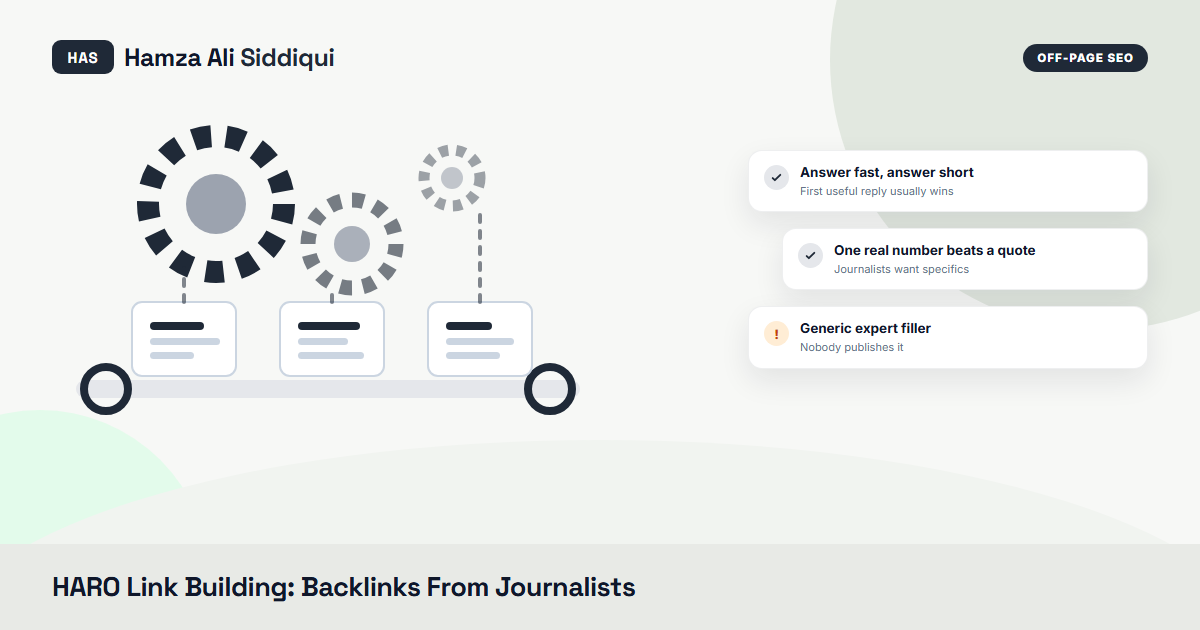
A popular query on any of these platforms gets 30 to 80 replies within a few hours. Journalists skim, not read. The pitches that get used share the same three traits, and the ones that get ignored share the opposite three:
- Answer first, credentials second. The first two lines should directly answer the question. Bio and site link go at the bottom, not the top.
- One specific number or example beats three vague claims. “We saw a 34% drop in cart abandonment after X” gets quoted. “Great UX reduces cart abandonment” does not.
- Reply inside the first two hours. Most journalists work through the first batch of replies and stop once they have enough quotes. Pitches sent after hour six are mostly wasted effort.
The pitches that get ignored are usually generic PR-agency copy-paste, missing a real name and title, or padded with marketing language the journalist has to edit out anyway. If a journalist has to do editing work to use your quote, they will pick someone else’s instead.
A pitch template that has worked for my clients
This is close to the structure I use across Qwoted and Featured. It is short on purpose:
“[Direct one-sentence answer to the question]. [One supporting sentence with a specific number, result, or example from real experience]. [Optional second angle if the question allows for one]. — [Full name], [job title] at [company], [site link].”
No more than 120 words. If the platform allows a headshot and bio field, fill both out completely before you start pitching. Incomplete profiles get used less because they read as less credible to a journalist deciding between two similar quotes in a hurry.
What hit rate to actually expect
Set expectations correctly or you will quit after a week. Across the client accounts I manage, a realistic range is 1 placement for every 15 to 25 pitches sent, assuming the pitches follow the structure above and are relevant to the source’s actual expertise. That is a lower hit rate than guest posting outreach, but the links that come out of it tend to land on sites with real editorial standards and DR60+, which is difficult to buy or negotiate your way into through guest posting alone.
Volume matters more than any single clever pitch in HARO link building. Someone answering 3 to 5 relevant queries a day for a month will consistently outperform someone who answers one query perfectly once a week.
Mistakes that quietly kill your hit rate
Beyond slow replies and generic pitches, there are a handful of smaller HARO link building mistakes I see constantly when auditing a client’s source profile:
- Pitching queries outside your actual expertise. A marketing agency answering medical or legal queries gets filtered out fast, and some platforms flag accounts for it. Stay inside your lane even when a query looks easy to answer generically.
- Leaving the link field blank. Some platforms let you attach a link separately from the pitch body. Skipping it means even a used quote does not generate a backlink, only a name mention.
- Using a company name instead of a person. Journalists are writing for human readers and prefer quoting a named individual with a title over “a spokesperson for [Company].” Always pitch as yourself.
- Not following up when a journalist asks a clarifying question. A same-day reply to a follow-up question wins the placement over a source who takes two days to respond, even if the original pitch was weaker.
None of these are complicated to fix, but they are the difference between a source profile that converts and one that quietly gets ignored for months without anyone noticing why.
Where this fits in a broader link building plan
I treat HARO link building as one channel inside a wider system, not a replacement for the rest of it. It runs alongside off-page SEO tactics like digital PR and resource page outreach, and it complements paid placements when a client wants faster, more predictable volume — I cover the tradeoffs of that approach in my guide to buying backlinks. The advantage of journalist pitching specifically is cost: it is nearly free, the only real investment is time, and the links it produces are almost impossible to replicate through outreach or payment because they come from genuine editorial coverage.
Every link you win this way is an editorial one, which is why I treat journalist pitching as one channel inside a bigger plan for earning editorial links, next to data assets and free tools.
HARO link building: the bottom line
HARO link building in 2026 means working Qwoted, Featured, and Connectively instead of the original free tool, but the fundamentals of what gets a pitch picked have not changed. Answer fast, lead with a specific answer instead of a bio, and treat it as a volume game with a 1-in-20 realistic hit rate. Done consistently for a few months, it is one of the few link building channels that produces placements on sites no amount of outreach budget can buy directly.
Journalists rarely tell you when a quote goes live, so use the steps in how to check backlinks every couple of weeks to catch new mentions.
Frequently asked questions about HARO link building
Is HARO still active in 2026?
The original free HARO product shut down in mid-2025 after being folded into Cision’s paid Connectively platform. Most of the free query volume that used to run through HARO now runs through Qwoted and Featured instead.
Is Connectively worth paying for?
It is worth it once you already have a working pitch process and want more query volume than the free platforms provide. I would not start there — prove the channel works on Qwoted or Featured first.
How long does it take to get a placement from journalist pitching?
Most first placements land within 3 to 6 weeks of consistent daily pitching, though it depends heavily on how niche and quotable your expertise is on the topics being requested.
Do these links actually help rankings, or just brand visibility?
Both. The links are usually dofollow from high-authority news and publisher sites, which helps rankings directly, and the brand visibility from being quoted in recognizable outlets compounds separately in trust and referral traffic.
If you take one thing from this: HARO link building rewards consistency over cleverness. Show up daily on Qwoted and Featured, keep every HARO link building pitch under 120 words, and let the compounding do the work over a few months.