
Every link seller I have ever bought from says their links are permanent backlinks. Very few of them mean the same thing by it. Some mean “no monthly fee.” Some mean “we will replace it for 12 months.” A few mean nothing at all, and the link is gone the day the site owner sells the domain.
I have been buying and building links for clients since 2019, and in 2022 I started logging every paid placement in one sheet with the date it went live and the date it died, if it died. This post is what that sheet taught me: what “permanent” really means, how long links actually last, what a fair guarantee looks like, and how I check that a seller will still be around when the link breaks.
What Permanent Backlinks Actually Are
In the link market, permanent backlinks are links you pay for once. There is no renewal invoice next month and no “your link expires in 30 days” email. That is the whole definition. It is a billing term, not a promise about the future of the web.
The opposite is a rented or renewable link: you pay $30 to $100 a month and the link stays only while you keep paying. Those were common on PBNs and sidebar link networks, and most of them disappeared once Google got good at spotting them.
So when a vendor sells a “permanent” guest post or niche edit, read it as “one payment, and we expect it to stay.” Nobody controls a site they do not own. The editor can change, the blog can be pruned, the domain can expire. Ahrefs looked at this in its link rot study and found 66.5% of links to sites over a nine year window were dead. Pew Research found 38% of webpages from 2013 were gone a decade later. Links decay. The question is how fast, and who pays when they do.
How Long Paid Links Lasted in My Own Tracking
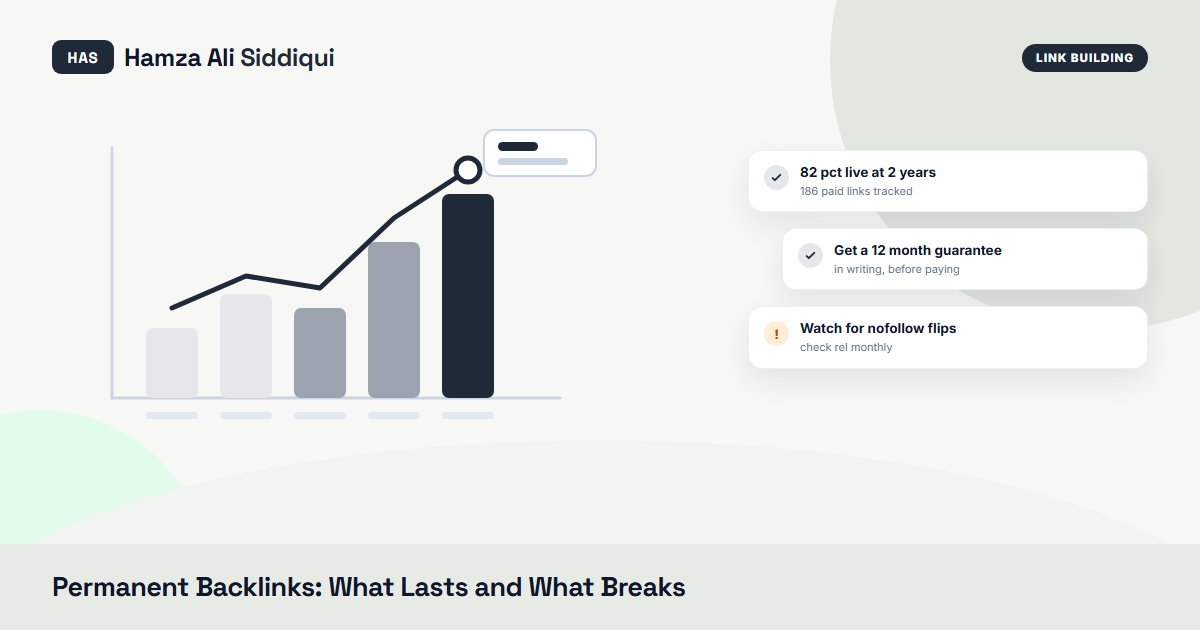
Between January 2022 and June 2025 I logged 186 paid placements for 14 clients. All were sold as permanent backlinks. Mostly guest posts and niche edits on real blogs with traffic, DR 30 to 70, nothing from obvious link farms. I re-crawled them every quarter.
| Time after going live | Links still live | Still dofollow |
|---|---|---|
| 6 months | 178 of 186 (96%) | 174 |
| 12 months | 169 (91%) | 163 |
| 24 months | 152 of 186 (82%) | 143 |
| 36 months (112 links old enough) | 83 of 112 (74%) | 76 |
Two things stood out. First, the first year is fairly safe. Losses speed up in year two, which is right around when most guarantees run out. Second, “live but changed to nofollow” is a real category. Nine links in my sheet stayed on the page but got a rel=”nofollow” or rel=”sponsored” added later, usually after a site owner read Google’s guidance on qualifying outbound links and did a sweep.
Why the links died
I went back through the 34 links lost inside 24 months and sorted them by cause. This is the part most guides skip.
- Content pruning (11 links). The site deleted or merged old posts to clean up thin content. Niche edits on old articles got hit hardest here.
- Domain sold or expired (8). The new owner wiped the blog or redirected everything to the homepage.
- Editor removed it after a policy change (7). New editor, new rules, all “sponsored” links stripped.
- Site migration broke the page (5). New CMS, new URLs, no redirects.
- Site hit by an update and abandoned (3). Traffic fell, the owner stopped paying for hosting.
Notice that only three of those are about the site being low quality. Most losses come from ordinary business decisions by people who never think about your link. That is why “is the site good?” is only half the check. The other half is “is this a site where things change a lot?”
Buying Permanent Backlinks: What the Guarantee Should Say
A guarantee is the only part of permanent backlinks you can hold anyone to. I ask for it in writing before I pay. Here is how I rate the terms I see.
| Guarantee term | My take |
|---|---|
| “Lifetime” with no details | Means nothing. Ask what happens if the domain is sold. |
| 6 months replacement | Too short. My data shows 4% loss by then, so it costs the seller almost nothing. |
| 12 months replacement | The minimum I accept for anything over $150. |
| 24 months replacement or refund | What I push for on links over $300. Some sellers agree if you ask. |
| Replacement “of equal value” | Fine if equal is defined: same DR band, same niche, similar traffic. |
| Covers nofollow changes | Rare, but ask. A link flipped to nofollow is a lost link for SEO. |
One more thing: the guarantee is only as good as the seller’s lifespan. I have had two vendors with “lifetime” guarantees simply vanish, Telegram account deleted and all. A 12 month promise from someone who has been selling since 2018 beats a lifetime promise from someone who started last spring.
A Worked Example: Permanent vs Rented Links on a Real Budget
Last year a SaaS client asked whether to spend $3,600 on rented links from a “link network” at $50 per link per month, or on one-time placements. The numbers are simple once you write them down.
- Rented: $3,600 buys 6 links for 12 months ($50 x 6 x 12). On day 366 they have zero links unless they keep paying.
- One-time: At $180 average per guest post at the time of writing, $3,600 buys 20 placements.
- Apply my decay numbers: after 24 months roughly 82% survive, so about 16 of the 20 are still live, and any lost in year one get replaced under a 12 month guarantee.
- Cost per live link-year: rented = $600. One-time over two years = $3,600 divided by about 36 live link-years, so roughly $100.
That gap is why I stopped recommending rented links years ago. The risk side matters too. Rented network links tend to sit on sites built only to sell links, which is exactly what Google’s link spam policy describes. If you want to price your own placements, my guest post price calculator gives a fair range by DR and traffic.
My 9-Point Check Before I Pay for a Permanent Link
This is the list I run on every site before buying permanent backlinks now. It takes about 15 minutes per site, and it has cut my two-year loss rate noticeably since I started using it in 2024.
- Domain age and expiry date. Check WHOIS. A domain that expires in two months and was registered last year is a red flag.
- Ownership changes. Look at the Wayback Machine. If the site was about dog food in 2021 and crypto in 2023, it was flipped and will be flipped again.
- Traffic trend, not traffic number. A steady 3,000 visits beats a site that fell from 40,000 to 8,000 last year. Falling sites get abandoned.
- Age of the posts they sell on. New guest posts survive better than niche edits on 2017 articles, which are first in line when pruning starts.
- Look for an existing nofollow sweep. Open five old guest posts. If links that used to be dofollow are now sponsored, the site already did a cleanup.
- Editorial contact. I want an editor’s name, not just a Gmail address on a “write for us” page.
- Guarantee in writing, with the length and what counts as a replacement.
- Indexing. If the page is not indexed, the link does very little. I covered how to check that in this guide to checking if backlinks are indexed.
- Anchor text. Keep paid anchors mostly branded or partial. Run your profile through the anchor text ratio checker before adding more exact match.
How I Monitor Links After They Go Live
Buying permanent backlinks is only the first step. A guarantee is worthless if you notice the loss in month 14 and the guarantee ended in month 12.
When a link does drop, do not write it off straight away. Some come back with a polite email, and many “lost” links turn out to point at a URL you broke yourself. My link reclamation process shows how I triage those and win back the ones worth chasing.
My routine is plain. Every placement goes into a sheet with: live URL, target URL, anchor, seller, price, date live, guarantee end date. Once a month I paste all live URLs into a link checker and look for three things: page returns 200, link still on the page, rel attribute unchanged. Anything that fails goes back to the seller the same week, with a screenshot. I also set a calendar reminder 30 days before each guarantee ends to do one last check.
For a client with 60 links this takes me about 40 minutes a month. Most months nothing breaks. The month something does, you get a free replacement instead of a quiet loss.
Mistakes I See People Make With Permanent Backlinks
- Paying more for the word “permanent.” Every one-time link is permanent in the billing sense. It is not a premium feature, so do not pay a premium for it.
- Buying niche edits on very old posts. Cheap, yes, but they are the first thing pruned. My losses on edits to posts older than five years were about double my guest post losses.
- Not saving proof. No screenshot, no date, no claim. Sellers will argue the link “was never there.”
- Ignoring rel changes. Checking only that the URL loads misses the sponsored or nofollow flip.
- Bulk “1000 permanent backlinks” packages. These are profile links, comments and spun pages. Permanent, maybe. Useful, no. I explain the difference between real placements and junk in my guide to paid backlinks.
So, Are Permanent Backlinks Worth It?
Yes, if you treat “permanent” as a billing term and protect yourself with a real guarantee and a monthly check. One-time placements on stable, real sites are still the best value per link I know of. Expect around 80% of them to be alive after two years, budget for that, and you will not be surprised.
If you would rather not chase sellers and spreadsheets yourself, this is what I do every day. You can see how I handle placements and replacements on my buy backlinks page, or read about my link building services.
FAQ
Are permanent backlinks really permanent?
No. Permanent backlinks are links with a one-time fee, not links that can never disappear. In my tracking about 91% survived one year and 82% survived two years. Sites get pruned, sold and migrated, so plan for some loss.
How long should a permanent link guarantee last?
Ask for at least 12 months of free replacement on any link over $150, and push for 24 months on expensive placements. Make sure it also covers a link being changed to nofollow or sponsored.
Is it safe to buy permanent backlinks?
Buying links that pass PageRank is against Google’s spam policies, so there is always some risk. The risk is much lower with real editorial sites that have their own traffic, branded or partial anchors, and a natural pace of new links.
Are permanent links better than rented links?
In almost every case I have priced, yes. In my worked example a one-time link cost about $100 per live link-year against $600 for a rented one, and rented links tend to sit on networks built only to sell links.
What should I do when a permanent backlink disappears?
Send the seller a screenshot and the original live date the same week you notice it, and ask for the replacement in your guarantee. If there is no guarantee, ask the site owner directly whether it was removed on purpose. Sometimes it was a migration and they will restore it.