
Tiered link building is one of those tactics that sounds clever on a sales call. You build links to your site, then you build more links to those links, and the extra authority is supposed to flow down the chain to your money page. I have been building links for clients since 2019, and I get asked about it at least twice a month, usually by someone who just received a cheap “tier 2 booster” offer.
Here is my honest take up front. The classic, automated version of tiered link building is a risk I will not take with a client’s domain. There is a small, manual version of the same idea that I use all the time, and it works. This post covers both, with real numbers from my own audits.
What is tiered link building, exactly?
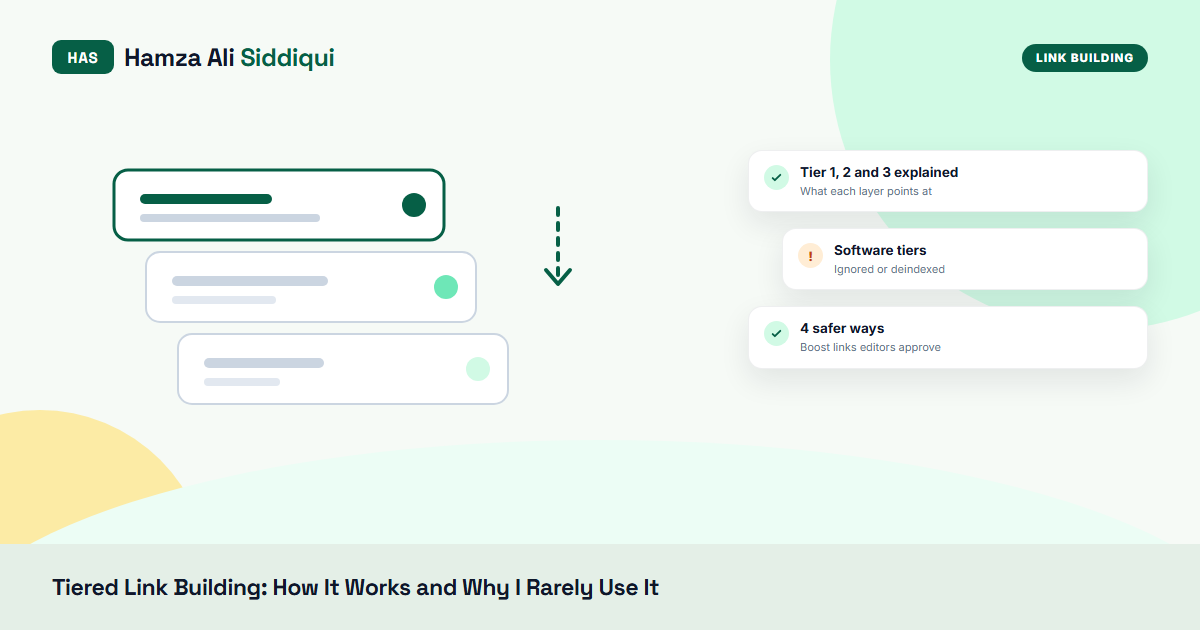
Tiered link building is a structure of backlinks arranged in layers. Tier 1 links point straight at your website. Tier 2 links point at the pages that hold your tier 1 links. Tier 3 links point at tier 2, and so on down the pyramid.
The idea comes from the original PageRank model, where a page passes part of its authority through each link it carries. Make the linking page stronger, the theory goes, and the link it gives you gets stronger too. On paper that is true. In practice it depends entirely on what the extra links are made of.
| Tier | Points to | Typical source | Typical price | My risk rating |
|---|---|---|---|---|
| Tier 1 | Your site | Guest posts, link insertions, PR mentions | $120 to $600 per link | Low, if editorial |
| Tier 2 | Tier 1 pages | Web 2.0 blogs, article directories, PBN posts | $20 to $80 per 100 links | Medium to high |
| Tier 3 | Tier 2 pages | Blog comments, forum profiles, software blasts | $5 to $15 per 1,000 links | High |
Prices above are what I saw quoted at the time of writing. Most sellers stop at three tiers. I have seen pyramids with five, which usually means the bottom layer is pure software spam. Your tier 1 should always be real contextual backlinks inside articles people actually read. Everything below that is where the trouble starts.
Why people used tiers in the first place
Before 2012, raw link volume really did move rankings. Google’s Penguin update in April 2012 went after sites whose profiles were built on exactly that kind of volume. Link builders reacted by putting a layer of cleaner links between the spam and the money site. If Google punished anything, it would hit the buffer pages instead.
That tiered link building logic still gets repeated on sales pages in 2026. The problem is that Google changed how it handles spam links. It mostly stopped treating them as a penalty trigger and started ignoring them. Google’s own post on the December 2022 link spam update explains that SpamBrain was used to neutralize unnatural links. So a tier 2 blast is more likely to do nothing than to help. And doing nothing is the good outcome.
A tiered link building audit from a real client
Numbers make this clearer than theory. In early 2024 a B2B software company came to me after eight months of flat traffic. A previous vendor had sold them 12 guest posts plus a “tier 2 power boost” on each one, which is tiered link building under a friendlier name. This is what I found when I pulled the data:
- 12 tier 1 guest posts on sites between DR 28 and DR 51, which were fine on their own
- 3,140 tier 2 links pointing at those 12 guest post URLs, mostly spun articles on free blog platforms
- 9 of the 12 guest post pages no longer indexed in Google
- $2,400 paid for the guest posts and $780 for the boost
The third line is the one that matters. When a page on a host site suddenly picks up hundreds of junk links, I often see Google drop it from the index. A page that is not indexed passes nothing to you. So the $780 did not just fail. It made the $2,400 they had spent on real links close to worthless.
A disavow file could not fix this, because those tier 2 links pointed at other people’s websites, not at the client. Nobody could delete a few thousand throwaway blog accounts either. So I emailed the 12 editors, explained what had happened, and asked 5 of them to move the link into a fresh article on the same topic.
Four said yes. Those four new pages were indexed within three weeks. Over the next four months the client’s target page moved from position 31 to position 14 for its main term. I won’t claim the tiered links alone caused the stall, but getting clean pages back into the index was the only thing we changed.
What Google says about tiered link building
Google never uses the phrase in its guidelines, but the link spam section of its spam policies covers it directly. Links created by automated programs or services count as link spam. So do links bought to pass ranking credit. A tier 2 network exists for no other reason, so it sits right inside that definition.
In the audits I have run since 2022, I see three outcomes, listed here from most to least common:
- Ignored. The lower tiers are never crawled or get discounted. You lose the money and nothing else.
- Tier 1 pages deindexed. The host page drops out of Google, which kills the one link you actually wanted.
- Manual action. Rare now. I have seen two, and both sites had also pointed software links straight at their own inner pages.
What tiered link building costs in 2026
If you still want to price tiered link building out, here is what I found on 14 vendor pages and marketplace gigs in August 2026. Treat these as ranges, not quotes.
| Offer | Typical price | What you usually get |
|---|---|---|
| Tier 2 booster, per tier 1 link | $15 to $40 | 100 to 300 Web 2.0 and article links |
| Full 3-tier pyramid | $90 to $250 | 10 posts on low-DR blogs, 500 tier 2, 5,000 tier 3 |
| Managed tiered campaign | $400 to $1,500 per month | Usually PBN posts at tier 1 with software tiers below |
| Hand-built tier 2 (the safe kind) | $150 to $300 per link | One editorial link to an existing guest post |
A $250 pyramid looks cheap next to a single $300 editorial link. That changes fast once you count how many pyramid links Google even looks at. If you want to see where honest pricing sits, my breakdown of link building packages walks through each price tier.
4 safer ways to get the benefit of tiered link building
The core idea behind tiered link building is sound. A link from a strong, indexed, visited page is worth more than a link from a page nobody reaches. So instead of blasting links at my placements, I make those pages stronger in ways a real publisher would welcome.
1. Ask the editor for internal links
When a guest post goes live, I send the editor two or three older articles on their own site where a link to the new post fits naturally. Editors like this because it helps their site too. Internal links from their ranking pages get the new post crawled and indexed quickly. I get a yes on roughly 6 out of 10 placements.
2. Send real people to the page
Share the post in the client’s newsletter, on LinkedIn and in any community where it is genuinely useful. A few hundred visits won’t change PageRank. They do get the page crawled, and they show the publisher the article was worth running, which makes your next pitch to them much easier.
3. Earn one editorial link to your best tier 1 pages
For the two or three placements that matter most, I earn a real link to the guest post itself. That might come from a resource page, another article I write, or a link insertion on a relevant post that already ranks. One of these does more than 300 Web 2.0 links. It is the only kind of tier 2 I will pay for.
4. Link to your placements from your own site
A “Featured in” or press page on your site that links out to your best articles gives Google another path to them. It costs nothing. Because the links sit on a site you own, you control the anchor text and can remove them whenever you like.
How to spot tiered link building sold under another name
Plenty of vendors no longer use the word “tiers”. I treat every one of these as the same offer:
- “Link juice booster” or “power boost” add-ons on a guest post order
- “Indexer” packages that promise to get your backlinks indexed with thousands of pings
- A per-link price under $20 next to a DR number that looks far too high
- Reports that count links in the hundreds but give you no URLs you can open
- Anchor sheets full of exact match keywords on the lower tiers
If a vendor refuses to show you the tier 2 URLs, walk away. There is a reason they are hidden.
Mistakes I keep seeing
Pointing tier 2 at pages you do not own. You are putting someone else’s site at risk. The publisher can remove your link the day they notice, and many do.
Exact match anchors on the lower tiers. People assume Google won’t look that far down. Those anchors still describe the tier 1 page and still get counted. If you have inherited a messy profile, run your anchors through my free anchor text ratio checker before building anything new.
Stacking tiers under PBN links. Two risky layers do not cancel each other out. Tiered link building on top of a PBN just gives Google two chances to find the pattern.
Paying for indexing blasts. If a tier 1 page still isn’t indexed after 60 days, the problem is on that page or that site. A thousand pings will not fix thin content or a host that Google has stopped trusting.
Should you use tiered link building? My rule
My rule is short. If the second layer is something a real editor or a real reader would create, do it. If it comes from software, a spun article or a network you would be embarrassed to show the client, skip it.
That is also why I have never sold tiered link building as a line item. The safe version is just part of looking after the links a client already paid for. Spend the pyramid budget on one more good placement and on getting your existing placements indexed. It is slower to set up and far easier to live with.
Before building any second tier, learn how to check backlinks on your tier-one pages so you know which ones are actually indexed and worth supporting.
FAQ
Is tiered link building black hat?
The automated version is. Google’s spam policies name links created by automated programs and links bought to pass ranking credit, and a software tier is both. Earning an editorial link to your own guest post is normal white hat work, even though it is technically a second tier.
Does tiered link building still work in 2026?
Not the software kind, in my experience. In audits since 2022 those links were either ignored or they got the tier 1 pages deindexed. Hand-built tier 2 links from real sites still help a strong placement pass more value.
What is the difference between tier 1 and tier 2 backlinks?
Tier 1 backlinks point directly at your website. Tier 2 backlinks point at the pages that host your tier 1 links, so they only affect your site indirectly, through those pages.
Can tiered links get my site penalized?
A manual action is rare if the spam only points at other sites. The more common damage is losing the tier 1 pages from Google’s index, which wipes out the value of links you paid real money for.
How many tier 2 links should I build?
I do not build them in bulk at all. For a site with 20 guest posts, I would earn one real editorial link to each of the best 3 to 5 placements and ask editors for internal links on the rest.