
Most people who decide to outsource link building make the decision in about ten minutes and then spend six months paying for it. I know because a good share of my clients came to me after that second phase. They had a vendor, a monthly invoice, a spreadsheet of URLs, and no idea whether any of it was helping.
I have built links since 2019, first for my own sites, then for agencies as a white-label supplier, and now for direct clients. So I have sat on both sides of the table. This post is the process I would follow if I were the client: when it makes sense to hand the work over, what it really costs compared to hiring, the brief I would send, the 30-day trial that exposes a bad vendor, and the contract lines that protect you.
Should you outsource link building at all? A 2-minute test
Outsourcing is not always the right answer. Before you look at a single agency, tick the boxes below honestly.
- Your site already has pages worth linking to: service pages that convert, or guides that answer a real question.
- Technical basics are fixed. Links pointed at a page Google cannot index are wasted money.
- You can spend at least $1,000 a month for six months without panicking in month two.
- Nobody on your team has 15 to 20 hours a week free for prospecting and outreach.
- You know which 3 to 5 pages matter most for revenue.
Four or five ticks: it makes sense to outsource link building. Two or three: fix the gaps first, or buy a small test package. Fewer than two: spend the money on content and on-page work, and come back later. I turn down roughly one inquiry in four for exactly this reason, because links cannot rescue a site that has nothing to rank.
In-house vs freelancer vs agency: a worked cost example
The usual articles tell you to outsource link building because it is “cheaper” and stop there. Here is the actual maths for a target most small businesses I work with ask for: 8 good links a month on sites with real traffic. Prices are what I see at the time of writing, in USD.
| Cost line (per month) | In-house hire | Freelancer | Agency |
|---|---|---|---|
| Salary or fee | $3,500 (mid-level, US remote) | $1,200 labour | $2,400 retainer |
| Tools (Ahrefs, Hunter, Pitchbox or similar) | $350 | Included | Included |
| Site fees / content for 8 links | $1,000 | $800 | Included |
| Your management time (5 hrs at $60) | $300 | $300 | $150 |
| Total | $5,150 | $2,300 | $2,550 |
| Cost per link | $644 | $288 | $319 |
| Months before links start landing | 2 to 3 (hiring, ramp-up) | 1 | 1 |
The in-house number only wins when you need 25 or more links a month for years, because the salary and tool costs get spread thin. Below that, it is cheaper and faster to outsource link building. The freelancer column looks cheapest, but it carries the highest variance: a great freelancer beats most agencies, and a bad one sends you 8 links from sites that exist only to sell links. If you want to test these numbers against your own niche, my link building cost breakdown goes through prices per link type, and the guest post price calculator gives you a fair range for a single placement.
The four ways to outsource link building
When people say they want to outsource link building, they can mean very different deals. Know which one you are buying, because each one fails in its own way.
- Managed campaign. The vendor picks targets, writes content, does outreach, and reports monthly. Best for owners with no SEO person. Main risk: you lose sight of what is being built in your name.
- Pay per link. You order links at a fixed price with minimum metrics. Easy to budget and easy to compare. Main risk: the vendor meets the metric on paper with sites that have fake traffic.
- Packages. Fixed bundles, say 5 links for $1,500. Good for a trial. Main risk: cookie-cutter placements that ignore your pages. I wrote about how to read these in my post on link building packages.
- White-label. An agency resells another supplier’s links under its own brand. Fine if the agency checks the work. Main risk: two layers of margin and nobody who actually owns quality.
The brief I send before I outsource link building
A vague brief gets vague links. When I hire another supplier for overflow work, and yes, I do that in busy months, this is the one-page brief I send. Copy it.
- Target pages: 3 to 5 URLs, ranked by priority, with the keyword each one should rank for.
- Anchor plan: the split I want, for example 50 pct branded or URL, 30 pct partial match, 20 pct generic, and a hard cap on exact match. I check this later with my anchor text ratio checker.
- Minimum site standard: real organic traffic of 1,000 or more a month in Ahrefs, traffic trend flat or rising, no “write for us” footer, and an outbound link count that looks normal.
- Topics allowed: the niches that make sense for my site, plus two or three nearby ones.
- Banned list: PBNs, link farms, casino and adult neighbours, sites that sell links on a public price list.
- Content rules: no AI-spun text, one link to me per article, and at least one other useful outbound link.
- Reporting: live URL, anchor, target page, the site’s traffic on the day it went live, and the price paid for each link.
That last line matters most. A vendor who refuses to show the site’s traffic at the time of placement usually has a reason.
Run a 30-day trial before you sign anything long
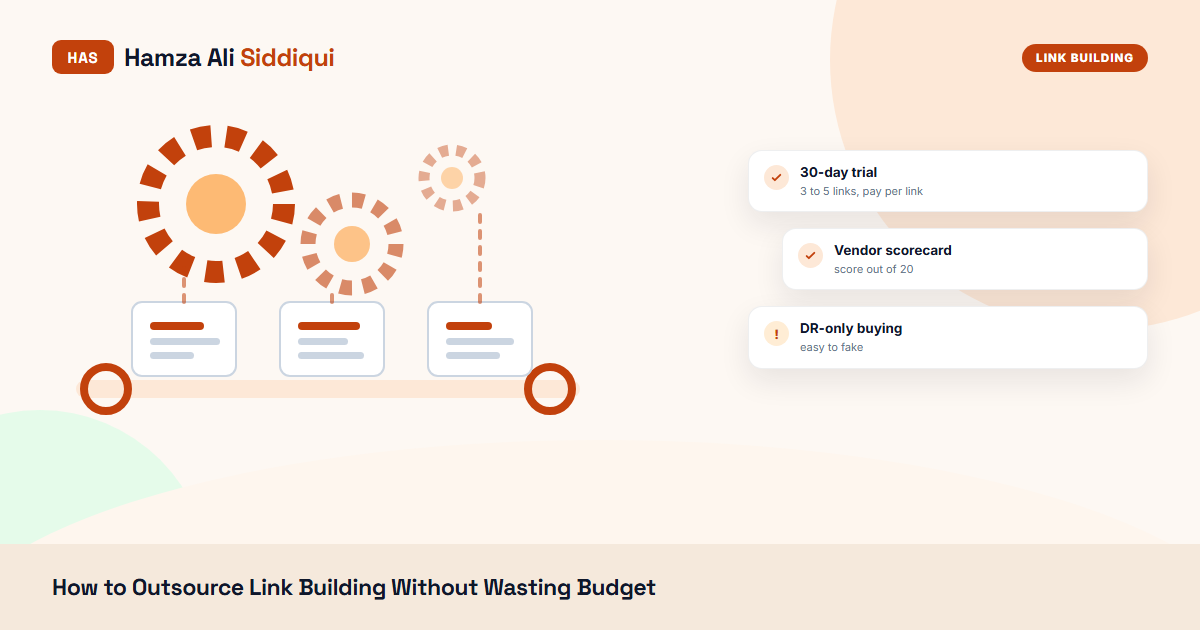
Never start with a six-month contract the first time you outsource link building. Order 3 to 5 links, pay per link, and put every placement through this check.
- Day 0: write down the current rankings and referring domains for your target pages.
- Day 1 to 21: the vendor delivers. Ask for a short list of prospects before they pitch, so you can veto sites early.
- On delivery: open every live URL. Check that the page is linked from the site’s own menu or category archive, not orphaned in a hidden folder.
- Day 7 after delivery: confirm each page is indexed. My guide to checking if backlinks are indexed shows the quick way.
- Day 30: look at the traffic chart of every linking site again. If two out of five crashed in a month, the vendor is buying from link sellers.
Do not judge the trial on rankings. Thirty days is too short for that. Judge it on the quality of the sites, the honesty of the report, and how the vendor handles a rejected prospect.
My vendor scorecard
Before a client of mine decides to outsource link building to a new supplier, I score that supplier out of 20. Anything under 12 is a pass for me.
| Check | Good sign (4 points) | Bad sign (0 points) |
|---|---|---|
| Sample links | Shows 10 live links from last quarter with traffic | Only shows DA or DR screenshots |
| Prospect approval | Sends a list for your OK first | “We handle everything, trust us” |
| Pricing | Clear per-link or per-month price with what is included | Price changes after you share your URL |
| Replacement policy | Free replacement if a link drops within 6 to 12 months | No policy, or 30 days only |
| Method | Explains how links are earned: outreach, content, digital PR | “Private network”, “guaranteed DA 50+ in 7 days” |
Contract lines that protect you
Most link building agreements are one page and favour the seller. Ask for these four lines in writing:
- Ownership: any content written for the campaign belongs to you, and so does the prospect list for your account.
- Replacement window: links removed or changed to nofollow within 6 months are replaced free.
- No-network clause: the vendor confirms it does not own or control the linking sites. If it later turns out they do, you get a refund.
- Exit terms: 30 days notice, no lock-in after month three.
One more point people forget. Google’s spam policies treat buying links for ranking as link spam, and the penalty lands on your site, not on the agency. Paying someone for their outreach time is normal. Paying a site owner for a dofollow placement is the grey zone, and Google asks for those to be marked with rel=”sponsored”. Know which one your vendor is doing. I cover that line in detail in my post on paid backlinks.
What a good monthly report looks like
Here is a real example, anonymised, from a SaaS client in month four after they chose to outsource link building to me. They paid $2,600 that month.
- 9 links live: 5 guest posts, 3 link insertions, 1 resource page mention.
- Median linking site traffic: 4,800 a month. Lowest: 1,300.
- Anchor mix this month: 4 branded, 3 partial, 2 generic, 0 exact.
- Cost per link: $289, with the site fee listed for each one.
- Target page “pricing comparison” moved from position 19 to 11 over the quarter.
- One link removed by the publisher, replaced on 14 August.
Notice what is not in there: a DA chart, a “total backlinks” number padded with directory submissions, or screenshots of a tool dashboard. If your report is mostly graphs and very few URLs, ask for the URLs.
Mistakes I see when people outsource link building
- Buying on DR alone. DR is easy to fake with spam links. Traffic trend is much harder to fake.
- Pointing every link at the homepage. Your homepage usually needs the fewest links. Money pages need them most.
- Switching vendors every two months. Links take time to show effect. I explained the typical timeline in how long backlinks take to work.
- Letting the vendor pick the anchors. Many default to exact match because it looks good in reports. That is how people end up over-optimised.
- Hiding it from the team. Your content writers should know which pages are getting links, so they keep those pages fresh.
- Paying the cheapest quote. Ahrefs’ study on link prices found an average of about $361 for a paid link insertion. If someone offers “DA 70” placements for $30, the maths says the site is a link farm.
When I would not outsource
Some cases are better kept in-house. If your links come mainly from digital PR tied to your own data, your team already knows the story better than any vendor. Same for local businesses whose best links are sponsorships, suppliers and chambers of commerce: a few emails from the owner beat an agency here. And if you have a strict brand voice, for example in finance or health, you may want in-house writers at least, even if you outsource link building outreach itself.
For everyone else, the way to outsource link building that works best is a mix: you own the strategy and the target list, and the vendor does the slow, repetitive outreach. That is how I run my own link building services. The client keeps the steering wheel, I do the legwork, and every link comes with its URL, traffic and price on the report. If you want me to look at a vendor proposal you already have, send it over through the contact page and I will tell you honestly whether it is worth the money.
FAQ
How much does it cost to outsource link building?
At the time of writing, most reputable vendors charge $200 to $450 per link, or $1,500 to $5,000 a month for a managed campaign. Under $100 per link usually means PBNs or link farms. My example above works out to about $290 to $320 per link for 8 links a month.
Is it safe to outsource link building?
It is safe when the vendor earns links through outreach and content, shows you every URL, and lets you approve prospects. It becomes risky when they sell placements from a network they control. The penalty hits your site, so check the work yourself.
Should I hire a freelancer or an agency?
A freelancer is cheaper and often more careful, but depends on one person. An agency costs a little more and can scale. For under 10 links a month I usually suggest a vetted freelancer; above that, an agency or a freelancer with a small team.
How long before I see results?
Most sites see movement on target pages in 2 to 4 months, and the full effect around 6 months. That is why a 30-day trial should be judged on link quality, not rankings.
What should an outsourced link building report include?
The live URL of every link, the anchor text, the target page, the linking site’s organic traffic on the day it went live, and the price paid. Anything without URLs is a sales deck, not a report.